Civil Society and American History

We find ourselves now at a turning point, confronted by the consequences of the past and the anger and confusion of the present.  Yet, this is an opportunity – a time that calls for clarity of purpose, and for coming to terms with the history that brought us here.

It is not political change that I speak of, but a far more profound transition.  We are confronted with questions of principle, of values, of the meaning of moral responsibility.

Such concerns often come into sharper focus amidst disruption and conflict.

Answers do not come easily, but history leaves silent lessons etched in our national experience.

In my view, we have lost a sense of purpose, and thus the conceptual framework upon which rational judgment depends.  This has made us vulnerable both to our own vices and to the predatory interests and manipulative power of institutions that know our weaknesses.

We have indulged ourselves increasingly over time in our attraction to meaningless spectacle and thoughtless voyeurism – a wasteland of sex, violence, greed and materialism.

In his recent book, The Great Degeneration, economic historian Niall Ferguson provides a persuasive view of what has come to pass in the United States.  He considers four areas in which the degeneration of values and loss of social stability have had devastating consequences.

In my own words these are: 1) the loss of personal and social responsibility, 2) the disintegration of the market economy, 3) the role of the rule of law, and 4) the essential qualities of civil society.

Dr. Ferguson reminds us of past strengths, and in particular the vigorous civil and cultural life of nineteenth century America.

“I want to ask,” he writes, “how far it is possible for a truly free nation to flourish in the absence of the kind of vibrant civil society we used to take for granted?  I want to suggest that the opposite of civil society is uncivil society, where even the problem of anti-social behavior becomes a problem for the state.”

He goes on to cite Alexis de Tocqueville from his famous commentary, Democracy in America, published in 1840:

“America is, among the countries of the world, the one where they have taken most advantage of association and where they have applied that powerful mode of action to a greater diversity of objects.

“Independent of the permanent associations created by law under the names of townships, cities and counties, there is a multitude of others that owe their birth and development only to the individual will.

“The inhabitant of the United States learns from birth that he must rely on himself to struggle against the evils and obstacles of life; he has only a defiant and restive regard for social authority and he appeals to its authority only when he cannot do without it….

“In the United States, they associate for the goals of public security, of commerce and industry, of morality and religion.  There is nothing the human will despairs of attaining by the free action of the collective power of individuals.”

Dr. Ferguson writes that “Tocqueville saw America’s political associations as an indispensable counterweight to the tyranny of the majority in modern democracy.  But it was the non-political associations that really fascinated him.”

Consider Tocqueville’s description:

Americans of all ages, all conditions, all minds constantly unite.  Not only do they have commercial and industrial associations in which all take part, but they also have a thousand other kinds: religious, moral, grave, futile, very general and very particular, immense and very small; Americans use associations to give fêtes, to found seminaries, to build inns, to raise churches, to distribute books…. Finally, if it is a question of bringing to light a truth or developing a sentiment with the support of great example, they associate.”

What happened?  Once upon a time Americans succeeded in overcoming the constraints to freedom through their own initiative and a sense of community.

Today inaction has replaced action.  A once vibrant culture of engagement has been replaced by a self-centered attitude and the isolating influences of technology, mass media, and corporate society.

Will we recreate what we once did so well?  Shall we rebuild the American spirit and character to meet the challenges ahead?

Tom

A Note to Readers: A project description and a draft introduction to the book can be found on this page.  Please look for the next post on or about March 10.

America: Identity, Direction, Ultimate Purpose

Americans have been watching change accelerate.  These are not normal times.  I have been thinking about what has changed and why.  I’m especially interested in the ways our identity and character as a people have unfolded over time.

Is the change we have been experiencing in recent years all bad?  Can there be both positive and negative dimensions to events that force us to focus our minds and rethink our vision, direction, and values?

The inevitability of plural and conflicting values tests character.  While it is natural for values to be influenced by social conditions or challenged by events, it is when we stop paying attention that we are caught by surprise.

Living in a pluralistic society is a challenge and a responsibility.

It is with this concern that I wish to review some historical viewpoints.  I have no intention of passing judgment in this forum.  But, I think it is important to consider how we came to be where we are, and this is one dimension of my forthcoming book.

The American story is one of visionary hopefulness, realized in fits and starts over the course of more than two centuries.  It has been part courageous and inspiring, and in other aspects both baffling and troubling.  It is a work in progress.

Two concerns that I think are pivotal in any consideration of our national identity include our understanding of the vision and principles of the Founders, and, secondly, our mutual respect as citizens who respect that vision.

Personal independence and acceptance of individual differences are concerns of great significance to Americans.

Yet, there has been a clear divergence between the vibrant and spontaneous civic life that characterized much of early American history, and during the same period a record of violence and brutality revealing an arrogance that defied accountability.

Who are we, really?  Who do we want to be?

Anti-social behavior will evoke revulsion in most of us.  But, historically the dark side of individualistic egotism has been socially acceptable, even conspicuous, in racist attitudes and practices toward American Indians, African-Americans and other minorities.  We have an painful legacy of violence, accentuated by the degradation of slavery, drugs and prostitution.

And, the destruction we are seeing today is very great.  We have witnessed a profound deterioration of moral character and social responsibility in recent decades.

We live in a time of extremes.  Consider: Mass murder and sexual violence are escalating at an appalling rate.  Prior to 1960 mass murder in the United States was rare, with no more than several incidences per decade.  This has changed steadily since then.

In 2015 there were 333 mass shootings in the United States and 13,485 deaths by gunshot, with 697 children and 2,694 teens killed or injured.  In 2016 there were 385 mass shootings and 15,054 deaths by gunshot, with 670 children and 3,114 teens killed or injured. (Source: shootertracker.com)

This is but one example among many of the social degradation and abasement we can see all around us.

The current break down of social order has been complicated process.  The economic abandonment of working Americans and the destruction of the middle class has been taking place over several decades with little notice.  I believe parenting is also a factor.

A lack of perceptiveness and foresight among our political leadership and financial professionals has undermined social and economic stability on a broad scale.  Institutions we have depended upon are facing financial bankruptcy; systems are breaking down; people are losing their grip.

How is it that we have so completely lost our way, our sense of purpose, our understanding of the integrity of our place in the world?

We now find ourselves confronted by the practical consequences of material loss, fear and anger.  Most importantly, we have lost our sense of direction and ultimate purpose – and thus the conceptual framework upon which rational judgment depends.

The spirit is wounded.

If we wish to regain a civil society in which we join one another to resolve problems, we will need to step aside from unproductive bickering, extricate ourselves from the wreckage, and rise above our differences – to face the complex dangers that now confront us.

Tom

Note to readers:  In the coming weeks we will consider implications suggested by our national past through the eyes of historian Niall Ferguson, political philosopher Alexis de Tocqueville, and conservative commentator Richard Weaver.  Please look for the next post on or about February 24.

The Will to Freedom

When America was first being settled by Europeans, the emerging identity of the new nation was characterized by a hopeful confidence in the future and a belief that freedom would lead ultimately to general prosperity and peace.

A new understanding of history had, in the words of political scientist and philosopher Michael Allen Gillespie, “opened up the possibility that human beings need not merely accommodate themselves to the natural world.  Instead they could become masters of nature and reshape it to meet their needs through the methodological application of will and intelligence. This new understanding of the relation of man and nature had profound implications for man’s own understanding of his place in time.”

The “will to freedom” as conceived by philosophers and treasured by American settlers and colonists, thus became the dominant theme on a continent that seemed unlimited, but for the noble peoples it displaced.

We have not been willing to tolerate anything that stands in our way, including those once proud and independent indigenous American peoples who, despite heroic resistance, were forced to give ground to the relentless advance of western expansion.

The contradictions hidden in the vision of absolute freedom and unlimited prosperity have remained largely unconscious and unresolved, whether they be social, economic, or physical.

Forced by extraordinary circumstances, our attachment to illogical assumptions and inflexible absolutes is today pitching us into a confusion of emotionally charged philosophical and political conflicts.

Several related questions were raised in previous posts.

Do we still think we can make ourselves “master and possessor of nature” without regard for the coherent balance that physical life depends upon?

Is absolute freedom even possible, given the complexity and destructive potential that science and technology have introduced into our lives?

What do we expect of technology?  What of the vulnerability of aging infrastructure we depend on for electricity and water every day, or the steadily growing impact of robotics on the economy and jobs, or swiftly advancing surveillance technologies that are capable of prying into every corner of our lives?

Finally, what do the changing realities we face today suggest about the practical meaning of freedom and responsibility – and the necessity for cooperative problem-solving?  Can we collaborate with one another to address these questions and retake control of our destiny as wise, creative, and courageous people?

The historic questions have taken on a contemporary quality, but they are essentially the same questions.  Earlier generations evaded these questions by exalting science and materialism above all else.  Consequently, the denial of a rational God and the suppression of a religious perspective diverted attention from a logical contradiction that transcended philosophy and belief.

When the constraints and limitations imposed by belief in an all-knowing and all-powerful God were disposed of with the cry of “God is dead!” they were immediately replaced by constraints and limitations imposed by belief in a supposedly mechanical natural world.

It was, of course, assumed that science would soon master nature, human beings would succeed in perfecting rational governance, and humankind would realize absolute freedom.

But, nature proved to be far more complex and unpredictable than was expected.  And, having rejected the God of traditional religion, humankind has found itself confronted with a severe discipline imposed by nature, and without the grace or guidance of a loving Teacher.

And “rational governance”?  Well, we have certainly witnessed in graphic terms the manner in which self-appointed leaders of “rational thought” led us into the totalitarian nightmares of communism, fascism, and Nazism.

Please make no mistake: This past is not far behind us.

If we are to reconsider the cataclysms of the first half of the twentieth century and the horrific consequences of the many bungled attempts to control human destiny – politically, economically, and scientifically – we might start to see the future more clearly.  Indeed, we might then avoid potential disasters before they befall us.

We cannot neatly sidestep such fundamental unresolved questions, which I would suggest have embedded themselves deeply in the American psyche.

Agreement concerning the details is not required, but taking responsibility for the practical consequences of our actions in the real world is of immense significance.

Tom

Next post: Transcending Our Limitations

A note to readers:  Please watch for the next post on or about January 13.  Regular readers can register for email alerts by clicking “Follow” on this page.

In Response to Violence

Jay Scoffield is a recently retired police detective and regular reader of this blog. He responds here to our earlier discussion of safety and self-defense (blog posts 5-26, 6-3).

In addition to being a patrolman and detective, Jay has served as a field training officer and his Department’s first mental health liaison officer.  He also taught part-time at his local community college for 16 years while a police officer.  The courses he taught included self-defense and domestic violence, among others.  His thinking reflects a constructive attitude and deserves consideration.

Art, Skill, and Intention

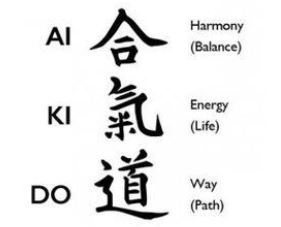
I have practiced various means of self-defense throughout my career as a police officer. While I have trained in many, Aikido found me.  I want to share my thinking here about a method of self-defense that I consider particularly effective, both physically and as a means of progress toward a world I can believe in.

I don’t see Aikido as the only answer available to us when those tense moments come. But I do find the philosophy of Aikido compelling. I offer a short summary here that reflects my training and experience.

Having compassion for people is at the heart of what passionate people do. I appreciate the Greek definition for compassion, to care from deep within oneself. For instance, the Bible refers to “the bowels of mercy” using a verb sometimes translated from the Greek as “to be moved with compassion or kindness” (Matthew 14:14, Mark 1:41, Colossians 3:12).

Mercy is an essential ingredient in justice, as is forgiveness.

Evidence exists of what some in behavioral sciences are calling the second brain; a brain that exists, if you will, in our gut. Scholars also suggest that each and every cell in our bodies gathers information concurrently with our brain. Humans can learn to do things very quickly. It’s a good idea to train our brain to check in with our gut, or that area where “the bowels of mercy” are located.

I think many of us have forgotten how to feel deeply, thus the path to being centered is lost. In the art of Aikido, we learn how to center ourselves.

aikido-2Centering is critical during hand-to-hand combat, and it is the centering of the emotional self that is necessary. Emotional centering involves gathering your internal energy with your mind and placing the energy two inches below your navel – the area of the “bowels of mercy.”

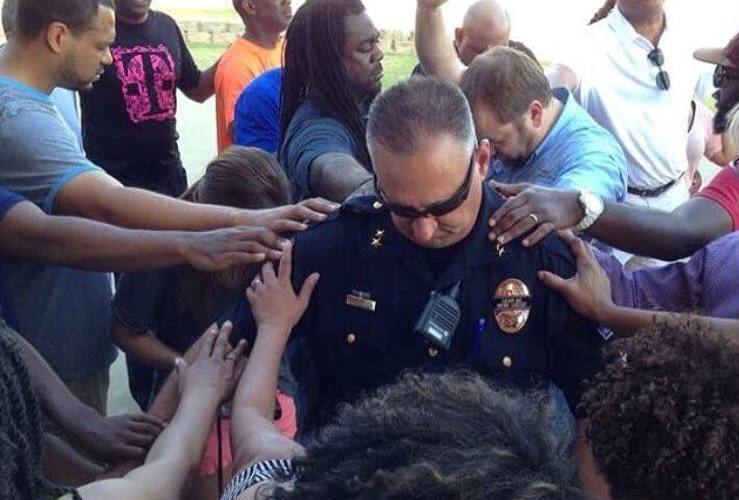
I function at my best when centered. Strangely, this helps one to function better when force is used. And centering can be helpful in situations that require force or diffusing.  If I am fully present and centered myself, I can center someone by my mere presence. Centering someone can be as simple as a touch to the shoulder or an empathic ear. Sometimes we may have to reach into our tool bag for other things.

When a police officer uses force the goal ought to be to get a person re-centered. This requires the officer to be centered before and after the use of force. After the use of force, the officer must lead the person to his/her path of re-centering. This can only be done with love and compassion.

Sadly, some folks will never be centered. Deadly force may be necessary to protect your life or the life of another. Could this be the penultimate experience for police work? I don’t think so. I think showing compassion and love is the ultimate experience.

This model can extend to extremists as well. We have dealt with militant forces before. Will love or compassion overcome these things? Sometimes I don’t think so. But at the end of the day, I truly believe humanity has the upper hand – a humanity based on love.

Jay Scoffield

Dear readers: The next post, “Freedom and Stability”, will initiate a series on the creation of the United States Constitution in 1787 as a visionary and pioneering structure for a newly emerging democratic republic.  Please look for it on or about September 30.

Unexpected Wisdom

How has the American identity developed amidst such a diversity of conflicting ideas and beliefs?  And, how has the clash of differing opinions contributed to strength?

The idea that unity is strengthened by diversity may at first sound counter-intuitive, but it is measurable and irrefutable.

In his book, The Wisdom of Crowds, James Surowiecki describes compelling evidence that large groups of people possess an extraordinary power to solve problems when their judgment is aggregated, and that the more diverse the crowd, the more efficient the solutions.

Citing a variety of examples Surowiecki presents a fascinating description of the conditions in which democratic decision-making does and does not work.

In his introduction to the book we hear of the surprise of scientist Francis Galton when 787 participants in a raffle at a county fair submitted guesses at what the weight of a large ox would be after it had been slaughtered and dressed.

“The analogy to a democracy, in which people of radically different abilities and interests each get one vote, had suggested itself to Galton immediately. ‘The average competitor was probably as well fitted for making a just estimate of the dressed weight of an ox, as an average voter is of judging the merits of most political issues on which he votes,’ he wrote.”

Galton, who expected to confirm his view that “the average voter” was capable of very little good judgment, borrowed the tickets from the organizers following the competition. He then ran a series of statistical tests on them.  Adding all the contestants’ estimates, he calculated the average.

The crowd had guessed that the ox, after it had been slaughtered and dressed, would weigh 1,197 pounds. In fact, it weighed 1,198 pounds.

Another example described by Surowiecki is the story of the 1968 loss of the United States submarine Scorpion, which disappeared in the Atlantic Ocean. The Navy had no idea what happened to the vessel, where it was or how fast it had been traveling.

Mr. Surowiecki recounts the story as told by Sherry Sontag and Christopher Drew in their book Blind Man’s Bluff, about how a naval officer named John Craven assembled a diverse group of people – mathematicians, submarine specialists, and salvage men – provided them with a number of varied scenarios, and asked them to offer their best guesses without benefit of contact with each other. All they knew was the sub’s last reported location.

The group laid wagers on why the submarine ran into trouble, on its speed as it headed for the ocean floor and the steepness of descent, among other things.

Craven built a composite picture of what happened and calculated the group’s collective estimate of where the submarine was. The location he came up with was not a location specifically suggested by any members of the group. But, that is where it was.

The Navy found the wreck 220 yards from where Craven’s group said it would be.

Mr. Surowiecki proceeds to demonstrate the surprising consistency of this outcome in widely varied circumstances. And, he explains how groups work well in some circumstances better than others.

As we all know, there are times when aggregating individual judgments produces a collective decision that is disastrous; a riot, for example, or a stock market bubble.

Interestingly, he writes: “Diversity and independence are important because the best collective decisions are the product of disagreement and contest, not consensus or compromise.

“An intelligent group, especially when confronted with cognition problems, does not ask its members to modify their positions in order to let the group reach a decision everyone can be happy with.  Instead, it figures out how to use mechanisms – like market prices, or intelligent voting systems – to aggregate and produce collective judgments that represent not what any one person in the group thinks but rather, in some sense, what they all think.

“Paradoxically, the best way for a group to be smart is for each person in it to think and act as independently as possible.”

Later in the present project, we will look at practical methods by which groups with diverse viewpoints can engage in creative problem-solving and decision-making in a manner that goes beyond consensus, even when face-to-face, to reach unexpected and mutually satisfying outcomes.

Tom

In two weeks: The challenge we must rise to.

Knowing Our Strength

The first step is ours to take.  We can address one another with dignity and join with our neighbors to resolve problems and address local needs.  Or, we can accept a world of hostility, disorder, and ultimate collapse as our children’s inheritance – and let the vision and the treasure of the American idea slip away.

The road to security is built with civility and paved with trust.  To make it so will be difficult.  It is, however, the only alternative to disaster.

The argument that the future can only be built on the foundation of dependable communities is as old as history.  It follows from the rational perception that conflict is a condition in human relationships and can only be understood and transcended in and through human relationships.

It is in the struggle with interpersonal relationships that direct and honest communication can take place.  The means for making this fractious process effective in the context of American history is the subject of this blog and forthcoming book.

Some may say that it is too late.  I say that Americans are courageous, resourceful, resilient.  The United States was conceived in controversy, and the pragmatic vision of the Founders came with recognition that wisdom and strength are found in diversity.

Indeed, it will be argued here that diversity is the foundation for strength, and that the United States Constitution is a visionary assertion of this belief.  The Founders gave us structure.  It is our responsibility to make it work.

Our answer to crisis will determine the shape of our future.  We find ourselves confronted today by one of the great tests of history, a challenge to the intent embodied in the Constitution and the coherence of the American vision that has been gradually maturing for more than two hundred years.

Perhaps we have lost our way for periods of time, stumbled, gotten sloppy.  But now it is time to pull together.  It is argued here that this must begin in our local communities – the historic home to pure democracy and the seat of civilization.

In a free society stability cannot be imposed from above. The kind of strength we seek is grounded in trust and the dependability of personal relationships.

I am not writing about a “recovery” from crisis in the normal sense.  Rather, I submit that we stand at the threshold of an unprecedented turning point – a dangerous crossroads, yet one that offers us a unique window of opportunity to affirm and uphold our exceptional and multifaceted identity as a nation.

In navigating through an extraordinary confluence of sequential crises we will be forced to renew our values, think on our feet, and make both pragmatic and ethical adjustments.  A creative process is now underway that would not be possible otherwise.

An assessment of shared values is in order, and reconsideration of the generosity of spirit that once made America so attractive to the world.

In September we will consider the foresight of the Constitutional Convention of 1787 that led to the system of protections, checks and balances that make the American structure of governance what it is.  First, however, we will examine the reasons why diversity has given America a dynamic strength – not as a nice idea, but as a pragmatic imperative.

If American communities are to emerge into a vibrant matrix of local and regional networks, they will depend on citizens with diverse skills and varied perspectives who are capable of teamwork and practical problem-solving.

Resistance to diversity often involves our discomfort with those we perceive as “outsiders”, people who look or think differently than we do, or who come from unfamiliar cultural backgrounds.  Yet, in crises, many differences will allow critical problem-solving that we can ill afford to do without.

It is important to feel confidence in our own ideas and values.  Yes, but why should we be afraid of different ways of thinking?

Aristotle said that “it is the mark of an educated mind to be able to entertain a thought without accepting it.”

The opportunity to explore the world through the eyes of others different from ourselves is a blessing and a gift.  And, in the event of social and economic collapse – it may be the key to survival.

Tom

Please watch for the next post on or about August 19:  The unexpected wisdom in diversity – how it happens and what makes it work.

Cooperation or Collapse?

And what of our differences?  The diversity of views and perspectives that divide Americans in the early years of the 21st century are unquestionably the deepest that have existed since the Civil War.

Our differences are based on many things today: ethical and religious values, economic disparities and personal experience with hardship, our understanding of history, and our perceptions of the very real dangers facing the world.

The vitality of the American Republic has always been energized by the clash of differing opinions.  The national character is rooted in the fertile engagement of divergent ideas that test and expand our wide-ranging perspectives.  America has flourished on the principle of pluralism.

Our opinions, values, perceptions all deserve respect; yet we disagree vehemently on matters of fundamental importance. We have good reasons for holding our views. This is the way it is supposed to be in a healthy civil society.

And this begs a critical question: How can we find a way to live and work together in a time of maximum stress?

As sequential crises take hold, is the security of our families and communities important enough that we are willing to do what is necessary to build trust and dependability, meeting life-sustaining needs and working effectively with our neighbors – many of whom we have substantial differences with?

Are we prepared to struggle for this country shoulder-to-shoulder, indeed to be truly loyal to one another as Americans?

And, what is it really that makes this a cause worth fighting for?

I believe that such questions lead to the pivotal question I have described on this blog as a “severe choice” (June 24).

Many readers have expressed concerns about the imposing challenges these questions represent.  Indeed, we stand at a monumental turning point in the nation’s history.

The survival of the Republic will require certain virtues that Americans are not generally known for—moral responsibility, dependability, trustworthiness.  Our most fundamental challenge will be learning to view others – especially our opponents – in essentially ethical rather than political terms.

This is not about charity.  A level of civility is required that goes far beyond kindness and common decency.  If Americans are to turn the corner, it will be with a civilized and responsible attitude that appears unfamiliar at present.

Cooperation does not require compromising our principles.  Indeed, unexpected opportunities for influencing one another will surely come with working together to address common needs, especially in the face of crises.

Times of danger tend to open ones’ personal perspective, allowing us to see with new eyes and hear with new ears.

It is neither practical nor civilized to go to war with one another when our common interests depend on our ability to communicate clearly and to engage in rational problem-solving.  What is essential is not that we agree, but that we seek dependable cooperation in the face of serious threats.

Naturally, this will require more than a right attitude.  Practical skills will be necessary to help us work effectively in small groups, ensure food security, make consultative decisions and manage conflict, organize projects and start small businesses.

Together we will share and develop the necessary skills.

Under the present conditions of social disintegration, strident divisiveness, and dysfunctional institutions, I have encouraged Americans to turn aside from partisan politics, at least temporarily, to focus primary attention on practical needs in our local communities.

I am not at all opposed to effecting change by traditional means. However, as the crisis deepens I believe we will gain far more safety and control over our lives through community building. And, I believe this effort will impart many of the essential lessons that will lead to a decent future.

This is my message.  Dependable community is the ground of civilization.

However complex the problems we face, in the final analysis we are confronted by a single simple question.  Will we accept the destruction of civilized society, a rending of the very fabric of the Republic, and retreat into a state of siege?  Or, will we have the courage to begin anew?

Tom

A note to readers: Please watch for the next blog post on or about August 5.

To believe absurdities…

Police 2 (BradWSutton)

“Those who can make you believe absurdities can make you commit atrocities.”  –Voltaire

(Photo credit: Brad W Sutton)


Endurance, Resourcefulness and Faith

The severity of a deepening crisis raises unavoidable questions. Will the country be torn apart by anger and frustration?  Will the nation survive as the Republic created by its founders? Or, will the American people have the vision, fortitude, and grit to learn the lessons and reaffirm the vision and principles that will lead to a genuine renewal?

If the Republic is to prevail, how will we pull it off?  Do we have the patience and wisdom to give priority first to the stability that makes problem-solving possible, to rebuild a national unity that transcends the very real differences that divide us?

Early in 2008 Peggy Noonan, a widely read conservative commentator and one-time aide to President Ronald Reagan, addressed this question eloquently in a collection of essays, Patriotic Grace, What It Is and Why We Need It Now.  She wrote during a season of bitter political back-biting, and, as we all know, things soon became very much worse:

“I believe we have to assume that something bad is going to happen, someday, to us.  Maybe it will be ten years from now, but maybe not, maybe sooner, much sooner.  We have to assume, I think, that it will be a 9/11 times ten, or a hundred, or more, and that it will have a deeply destabilizing effect on our country; that it will test our unity and our endurance, our resourcefulness and faith.

“We all know this, I think, deep down.  I don’t know a major political figure in America to whom all this has not occurred, and often…. And yet in some deep way our politics do not reflect our knowledge.  It’s odd.  Stunning, actually.  We keep going through the same old motions in the bitter old ways.  Even our cynics are not being realistic!

“…Will the banks fail, is the system built on anything but faith, and will the faith hold?  Will we keep our coherence as a country, will we hold together, can we continue as a sovereign nation at peace with itself?”

Peggy Noonan’s little book radiates a much needed spirit.  I recommend it.  Most of us never expected to see the United States in the condition in which we find it today.  Many of us never expected to face the personal hardship in which we increasingly find ourselves.

Ultimately we face a uniquely American crisis, yet one that is unfolding in the midst of an extraordinary global turning point.  I will attempt to cut through the emotions and complexity of a monumental moment in history to argue that we must unite to regenerate and rebuild the United States as a living model for a free, stable, and prosperous world.

This nation has progressed gradually toward maturity for 200 years, dedicated to the cause of responsible liberty and built upon the foundation of unity within diversity – diversity of nationality, religion, ethnicity, and, most of all, political philosophy.  We possess wide ranging distinctions and differences, but together we share an essential inviolable common ground.

We are all Americans.  The promise we all hold dear can only prevail if we have the courage and forbearance to rise above our differences, to address our problems shoulder to shoulder, and to do what must be done to make our children safe and our communities secure.

We have the inherent capacity to move forward despite the mistakes and tragedies of the past – and the mysteries of the future.

Our future hangs in the balance.  Let’s pull together, reassert our common ground in the vision with which the nation was built, and step forward to forge a future shaped by fairness, trustworthiness, and moral responsibility.

I submit to you that something far better, far nobler, something perhaps beyond our present ability to imagine, will emerge from the present turmoil.

If, however, we cannot work effectively to build safe communities with people we are not in complete agreement with, then we will be condemned to the only possible alternative: a collapsing civilization defined by fear and violence, a nightmare for our children, and a land where no principles, no values, no stable order can be realized.

Tom

Next post: Cooperation or collapse?

A note to regular readers:  As I announced in late June, I have shifted to a new schedule and will now post every two weeks.  This will allow me more time for completing the book.  I will continue to post on Fridays and hope to publish the next blog entry on or about July 22.

A Severe Choice

The extraordinary depth and breadth of the many crises confronting the American people today represent a critical turning point and test of America’s place in history.

For more than two hundred years the United States has stood before the world as a beacon of hope and an unparalleled model of political freedom, social diversity, and economic vitality.  People from throughout the world have been attracted to the vision it represents.

In the midst of upheaval it can be easy to forget the unique stature of the United States and the role it has played and will continue to play in the progress of an ever-advancing civilization.  Yet, our confidence in its’ social coherence, its’ economic well-being and generosity of spirit has faltered.

This blog, and the forthcoming book it represents, is addressed to those who are interested in understanding lessons from the past, and who recognize that failures of responsibility and foresight have led us to the brink of disaster.

Do we possess the resolve to join with one another in rebuilding the United States based on its core values and ultimate meaning?

In redirecting our attention and redoubling our commitment, it might be wise to consider those aspects of the American character and cultural attitude that have influenced the downward slide from responsibility to turmoil.

A self-indulgent materialism and thoughtless disregard for the consequences of our actions has placed the future in jeopardy.

The fragmented way we have perceived the world and led our lives may have origins in our immigrant past, but it will not serve us well in reconstructing a stable, coherent, and economically viable future.

There is much to think about.

However, my message is brief.  It will be short on analysis and will forego blame.  There is more than enough blame to go around and we all know about it.  Rather, I will focus on the essentials of mind and attitude, of human character, and of our relationships to one another that will be required if we are to turn despair into courage and failure into triumph.

We will address areas of concern that I believe to be central to realistic solutions.  Most importantly, we will consider the manner in which we relate to one another as individuals when we have very great personal differences.

I submit that the safety and security of our families and communities can only be assured if we unite around the structural order provided by the Constitution, which has anchored the American Republic from its inception, and to the principles of mutual respect and moral responsibility that give strength and resiliency to all civilized societies.

The United States has entered the fiery test of a crucible in which the forces of crisis will burn away the self-centeredness and sloppy thinking of the past to forge an American identity we can respect and feel good about.

If we fail to rise to our calling, however, the social violence generated by failing institutions and human suffering will threaten to incinerate our children’s future and turn a great vision to hopelessness and anguish.

At a time of extraordinary existential threat we are confronted with a severe choice.

Will we return to the founding ideals and principles of these United States as the bedrock on which to build a free and ethical future?  Will we defend and protect two hundred years of commitment, hard work, and sacrifice by generations of Americans who have given their lives to this unprecedented vision?

Or, will we give way to the emotions of uncompromising partisanship – and allow a great trust to shatter and vanish?

Infrastructure, systems, and services we have long depended upon are going to fail in the coming years. Problems will have to be solved without many of the tools and supports to which we are accustomed.  We will need to depend on one another in our local communities.

So, let’s set aside partisanship and sectarian differences when it becomes necessary in the interest of stabilizing and rebuilding the nation. Panic neither serves nor becomes us.

Tom

A note to regular readers:  Starting in July, I intend to post on alternate weeks.  This will allow me more time for completing the book.  I hope to post the next blog entry on or about July 8.  Have a good summer!

Someplace else…

Background 11 YogiBerra

“If you don’t know where you are going, you might wind up someplace else.”

–Yogi Berra


Ends and Means…

Music 4-x

“The principle that the ends justify the means is in individualist ethics regarded as the denial of all morals”

–F. A. Hayek

“He who chooses the beginning of the road chooses the place it leads to.  It is the means that determine the end.”

–Harry Emerson Fosdick

“An attempt to achieve the good by force is like an attempt to provide a man with a picture gallery at the price of cutting out his eyes.”

–Ayn Rand

“They say ‘means are after all means’.  I would say ‘means are after all everything’.  As the means, so the end.”

–Mohandas Gandhi

“The first sign of corruption in a society that is still alive is that the end justifies the means.”

–Georges Bernanos