Crisis and Opportunity

I am addressing these words to Americans for two reasons. I believe we have entered a period of severe, successive and interacting crises that promises to be deep, grinding, and long-lasting.

Secondly, I am concerned about the potential consequences of the increasingly bitter antagonism and disunity current among the American people.

Many of you are aware that the present predicament has been developing gradually over time. We have seen the loss of a once vibrant civil society, deterioration of the nation’s economic base, and a profound loss of social coherence and moral responsibility.

We each have a personal decision to make. Do we wish to recover the integrity of the United States as a constitutional republic? Are we prepared to rise above our differences, to engage personally with our neighbors, to instill the American spirit in safe, dependable communities?

These are among the questions that have inspired the forthcoming book. Our circumstances are already extreme. Nothing will be easy.

The United States and the world have arrived at an unprecedented turning point. We face a formidable array of complex crises. The challenges are diverse, profound, and mutually reinforcing. Some will impose themselves suddenly, others gradually, but all will ultimately converge as they impact upon our lives.

What is most extraordinary is the number and variety of crises that are emerging into view at virtually the same time: social and economic, moral and material.

An abbreviated review is offered here to demonstrate this diversity.

1) Increasing social instability characterized by a dramatic loss of civility, and by unrestrained anti-social behaviors that include accelerating incidences of brutality and mass murder.

2) A banking and monetary system that favors the financial elite rather than the American people, and which has become dominated by self-serving individuals who appear incapable of recognizing that their risk-taking behavior threatens the well-being of everyone, including themselves.

3) Massive government indebtedness, which constricts the economy and threatens Americans (and many others) with a dramatic devaluation of our dollar.

4) Ancient and deteriorating infrastructure that we depend on every day: bridges, municipal water and sewage systems, and the electrical grid. These will be almost impossible to upgrade or replace by governments already hobbled by indebtedness and shrinking revenues.

5) An exponentially increasing global population. With this comes rapidly increasing risk of global epidemics, as well as inevitable food shortages caused by falling water tables and a continual loss of arable farmland.

6) The rapid development of advanced technologies without a commensurate advancement of moral maturity or conscious sense of responsibility.

7) Degradation of the natural environmental systems that provide us with clean air and water, the consequence of population pressures and the long-term aggregate build-up of toxic substances derived from motor vehicles, household products, and industrial pollution.

8) A failure of parenting, and the emergence of a generation of youth untethered from reality and having little sense of moral, personal, or social responsibility.

9) Last, but not least, a profound loss of moral compass, balance, and integrity on a societal scale. This dramatic deterioration is overwhelming the values and norms of the past, and it is a crisis that impacts on all others.

There is more.

During the past century we have seen the emergence of integrated and digitized global systems that include transport, communication, and surveillance technologies, and a unified global monetary system. Consequently, no crisis can take place in any context without impacting on the whole.

A profound structural transition is taking place in human affairs that many have yet to recognize or understand.

How can such dire circumstances be called an opportunity?

For Americans the opportunity lies in the disruption of our lives – a disruption so profound that it cannot fail to alter our perspective, our thinking, and our willingness to cooperate with one another for the sake of local safety and security – whatever our politics or religion or the color of our skin.

And, if we can build viable local communities we can also begin the dialog to identify the practical extent of our shared values, and to develop a sense of shared vision and purpose that we can respect.

We must resist being dragged down, demoralized. We cannot react out of fear. We will stand firmly together, rising to the promise of our humanity with honor, dignity, and resourcefulness.

The identity of the nation is at stake.

Tom

Next week: A Confluence of Crises

The doorstep to wisdom…

People 14

“He who knows best knows how little he knows.”

–Thomas Jefferson

“The doorstep to the temple of wisdom is a knowledge of our own ignorance.”

–Benjamin Franklin

“People only see what they are prepared to see.”

–Ralph Waldo Emerson

Living with Differences

It can be difficult to work with other people for a variety of reasons. Some difficulties are easier to overcome than others. Often we can connect with people with a little creative sensitivity. But, sometimes it can require a great deal of patience and determination.

Why should we make this effort? There are critically important reasons to rise above our differences. To secure the safety of our communities and to resolve local problems, we will need “all hands on deck.” And, to seek a vision for the future that we can all get behind will require that we actually listen to and understand one another.

It is not necessary to compromise our personal views and beliefs. We each must maintain our personal dignity, integrity, and a confident sense of self.

That said, we will increasingly find it necessary to work with folks we may not feel comfortable with at first. The challenge is to be both self-confident and respectful as we engage with others to in the context of community.

Robert Heinlein made the point clearly when he said, “I never learned from a man who agreed with me.

Coming to understand the personality and perspective of another individual can be useful in itself, even if no possibility of agreement exists. It can be the means for crystallizing our own thinking and beliefs. And, if we approach it as a learning opportunity, we have much to gain from one another in knowledge, skills, and experience.

Aristotle is believed to have said that “it is the mark of an educated mind to be able to entertain a thought without accepting it.

Well, Aristotle did not go to high school, and neither have some of us. But, it is our job to figure out what he meant and learn how to do it!

It is important to respect the integrity and sincerity of every other human being, allowing our differences to exist freely in their own space, distinct from the roles of community-member, teammate, or friend.

Suppose we find ourselves dealing with a person who presents us with special challenges – perhaps someone who does not believe effective community to be possible, or who values their privacy to an extreme, or who just seems unreceptive?

It is almost always possible to work with someone who we find difficult if we are patient, creative, and open to finding a way.  It is important to understand from the beginning, however, that in such circumstances we cannot allow ourselves be emotionally needy or easily disheartened. Such an effort calls for a pleasant attitude and a generous spirit.

Often it is impossible to know why a person remains distant or unresponsive despite our best efforts. But, pain is often hidden there, whether it is conscious or not. And, caring will always give solace, however silently it is received.

The wise do not impose themselves until they obtain a hearing. If, however, we are able to plant the seeds of community in the fertile soil of the human heart, and water them gently with loving kindness, we may not have to wait long before their green shoots spring forth into the light of day.

When we make ourselves present in the life of another without expectation or demand, healing can take place without our knowing – until the dam breaks and the feelings flow.

We need not do more than simply be as fully present as that person will allow, and wait patiently in kindness until a response comes in the fullness of time.

It might take days, weeks, or years. But it will come.

In a little book called The Miracle of Dialogue (1963), the Christian theologian Dr. Reuel L. Howe wrote that “every man is a potential adversary, even those whom we love. Only through dialogue are we saved from this enmity toward one another. Dialogue is to love, what blood is to the body…. When dialogue stops, love dies and resentment and hate are born. But dialogue can restore a dead relationship.

Tom

Next week: Understanding the Long Crisis

Where the Work Begins

Living or working with other people might be the most difficult thing we ever do. Even a marriage can be hard work. And yet, if we wish to lead a meaningful life – or choose to rebuild the foundations of the American Republic – this is our core mission.

A spirited civil society is a central part of our American heritage. More than that, without dependable neighbors there can be no real safety or security. And, without trust nothing is dependable. These are prizes to be fought for and gained through consistent and determined effort.

Where do we start? How shall we navigate the inevitable bumps and bruises of working relationships?

When we become acquainted with someone who is emotionally mature and relatively open-minded it may not be hard to develop an understanding. If, however, we need to work with someone who suffers from anxiety or has wounds from the past, (or is convinced they already know everything), then building a constructive relationship will take time and labor.

This is almost always possible, if we have the patience and courage to persist, and if our circumstances allow us to proceed safely.

There are two basic requirements. The first is to get our thinking straight, to have a positive attitude and reasonable, clearly formed intentions. The second is to gain certain practical interpersonal skills. Both will be addressed in the book.

In any potentially sensitive interpersonal relationship it is wise to look beyond superficial impressions to recognize the free personhood and integrity of the other individual. New acquaintances may not seem attractive at first, or might seem more attractive than they deserve.

Each of us is a complex mystery. We can only come to genuinely know one another if we have the generosity of spirit to inquire and take interest. This can be a rich and meaningful experience.

Stephen Covey has written that “every human has four endowments – self awareness, conscience, independent will and creative imagination. These give us the ultimate human freedom…, the power to choose, to respond, to change.”

If we seek to build trust, and if we believe in freedom, all of these endowments must be recognized. Many of us are unaware of our own endowments, our own potential to grow and mature. And the surest way to learn and grow is in the effort to build functional relationships.

Many people will not share our vision or sense of purpose. They may not understand what we are inviting them to do, and may be distrustful until we prove ourselves. So, we need to communicate clearly, making sure we are understood, and find ways to work together. Such things take time and thoughtfulness.

We cannot wait for others to take the lead. The initiative must be ours. This is how we test our skills and put rubber to the road.

Elbert Hubbard said, “Responsibility is the price of freedom.” And Gandhi said, “You must be the change you want to see in the world.

Understanding comes through relationship, and the best way to build strong relationships is to team up to meet community needs. While spending relaxed time offers the possibility for meaningful conversation, it is in working together to address felt-needs and resolve practical problems that we really come to know one another.

Now, suppose we need to join forces with people who are very different from us. Perhaps our politics are at odds, or someone has religious or philosophical views that we find strange, or we simply see reality very differently. How can we get along – and actually trust another in difficult or dangerous circumstances? We will touch on this briefly next week.

Again, I believe the bottom line is this: In every matter our concern must be to preserve and deepen the level of trust, because we can expect to remain under the pressures of disrupted lives, deteriorating social conditions, and the threat of violence for a long time.

We can do this. We are a resourceful people. And we will get better at it as we make the effort.

Tom

Next week: Living With Differences

The Power of Teamwork

As we make our way forward through this long crisis, we can expect an erratic path to the future. The sequence of events will be unpredictable. Progress toward our ultimate goal will be diverted and delayed by repeated shocks and disruptions.

We must shore up our spirits and brace ourselves for frustrations. Sharing vision and purpose with others will steady our course – and our nerves.

Community spirit, and the success of communities in determining shared purpose and strategies for coping, will be critically important. This can only happen when we rise above our differences and come to understand and trust one another as friends, neighbors, and allies.

Readers are quite right to question how I can expect the intense antipathy and incivility current among the American people to allow us to actually sit down and attempt to understand and cooperate with one another.

You may think the idea impossible, even absurd. But, as I have tried to explain, we have no choice. Our failure to do this in good faith could result in the absolute loss of the American Republic and everything it stands for.

I think it interesting that our young people can commit themselves to discipline, teamwork, and decisive action in the armed forces – while the rest of us appear unwilling to exercise even basic civility, much less the generosity and loyalty that have characterized the American tradition.

It is not necessary to compromise our personal views and beliefs. The challenge is to be both self-confident and respectful as we engage with others to resolve local problems. This may require that we adjust our attitudes. Can we come to terms with one another as teammates and compatriots committed to the fundamental integrity of the nation?

No cohesive effort can be mounted, much less succeed, if we cannot get ourselves onto the same page. This is not possible if we cannot listen with understanding and communicate with civility.

The way we handle working relationships and resolve local problems will be the first stage in preparing for the future. A right attitude for dealing with an immediate crisis, as I suggested in an earlier post, will probably be the right attitude for working with one another to build a better future.

There will be confusion at times, and a failure to fully comprehend the nature of problems. Many of us are demoralized or under immense pressure. Those who have the presence of mind to engage in problem-solving will need to step forward to engage and pull people together.

Working with people can be one of the greatest tests in life. To assist readers in approaching the challenges of working with people – including those who are especially difficult to work with – the forthcoming book will offer supportive guidelines for a variety of conditions and circumstances. These will include:

1) Overcoming personal differences to build trusting personal relationships.
2) Facilitation of public meetings.
3) Group decision-making where differences of perspective or opinion are present.
4) Addressing conflict by means of an approach known as conflict transformation.
5) Working in groups to plan and execute projects.

I expect you are wondering what I mean by “conflict transformation”, mentioned in #4. This is a practical approach to conflict developed by John Paul Lederach and others. His book is The Little Book of Conflict Transformation.

Conflict transformation looks beyond resolution of the obvious issues on the surface of a conflict, to recognize and respond to the deeper factors that simmer below the surface – the roots of a conflict. It seeks first to understand and address perceptions and underlying causes; second, to reduce adversarial confrontation; and, third, to address the human needs relating to the conflict and to invite participation in finding constructive solutions.

I will try to give you a brief taste of my own thinking on building trust in personal relationships next week. Related commentary may appear in future blog posts, but to gain access to a range of practical tools and guidance you may purchase the book when it becomes available.

Tom

Next week: Building strong working relationships

Note to readers: A table of contents and several chapter drafts from the forthcoming book are posted on the blog site. See especially Chapter One: American Crucible and Chapter Six: The Ground of Freedom.

Wisdom at the Heart of America

Community is the seat of civilization, made genuine because it is personal. It is in our local communities that we engage one another face to face, cementing trust, tending to needs, learning patience and responsibility. And, here among friends and neighbors we can find the confidence to envision the future and look forward from the disorder of the present.

Our strength comes with diversity and our readiness to rise above our differences to build a vibrant, welcoming and free-spirited society. This is the essence of our heritage, our humanity, and the source of the nation’s greatness.

Trust and responsibility don’t just appear by good fortune. They are formed in the trials of necessity and hardship, and inspired by vision and purpose.

Like marriage, a commitment to community forces us to mature as adult people – emotionally, intellectually, and spiritually. Perhaps this is why so many avoid participating fully.

There are, however, other reasons for pledging ourselves to local responsibility. Beyond the boundaries of family, community is that place where immediate needs present themselves and must be resolved.

Americans have abdicated personal responsibility for these aspects of civilized life for a long time, and we have done so at our peril.

It was not always thus. Prior to the American Revolution, and for close to 100 years afterward, Americans gravitated easily, even impulsively, toward decentralized local governance and an independent frame of mind. We managed our own affairs in cooperation with our neighbors and accepted regional autonomy as a natural condition.

Civil society flourished in nineteenth century America, a vibrant force documented admiringly by Alexis de Tocqueville in his two volume commentary, Democracy in America. Americans created an immense variety of civic organizations to address every conceivable interest and social need. Citizens did this on their own initiative, inspired by their sense of belonging and the spirit of the times. There were few restrictions or restraints.

An American return to community, both in spirit and as a practical matter, is as important today as it has ever been. It can only be in direct engagement with our neighbors, and in all the spheres of problem-solving, that we will learn the skills of living and working productively with one another.

As Americans, we have been here before and we can do it again.

There are those who argue that the decentralist tradition of the American past represents an ideal to which we should aspire. Indeed, this is an attractive vision. Yet, I think it should be apparent for all to see that there must be a balance struck between a nation of fully engaged local communities and a competent and trustworthy central government that respects the primacy of local responsibility.

At the present juncture, as I wrote last week, it is difficult to imagine a limited central government managed by mature adults who are prepared to protect both our freedoms and our security. But, that is what we need. Without law there can be no freedom.

Rejecting centralized governance as something impossible to limit implies tremendous trade-offs. I believe that a valid and well-reasoned vision of limited government can come from local communities, the seat of wisdom at the heart of America.

How will this happen?

We can only accomplish this by means of a severe discipline anchored in a community-based culture. It will take courage and vision. Those who understand trust, moral responsibility, and constructive action – and who recognize the very high stakes involved – will build the foundations for an American renewal.

The best and the brightest will be leaders who serve with humility and little recognition.

It will be a gradual process that depends on each of us to reach out across differences of tradition, politics, and culture to influence hearts and minds, to form friendships and to truly understand one another.

It will take time because we will be initiating transformative change close to the heart of America, a profound influence on our cultural identity that partisan politics will be powerless to resist.

Tom

Next week: When big is not better.

Honesty

Coast 2-x

“Honesty is the first chapter in the book of wisdom.”

–Thomas Jefferson

“I am afraid we must make the world honest before we can honestly say to our children that honesty is the best policy.”

–George Bernard Shaw

Common Sense

Leaves 2

“We cannot solve our problems with the same thinking we used when we created them.”
–Albert Einstein

“Democracy is finding proximate solutions to insoluble problems.”
–Reinhold Niebuhr

“Society is always taken by surprise at any new example of common sense.”
–Ralph Waldo Emerson

Values That Matter

Readers responded last week to my request for thinking about shared values for a genuine American renewal. What values can we agree on, I asked, as a foundation for a unified starting point – a common American “center” that transcends culture, religion, politics?

[This exchange of ideas took place primarily on the blog’s Facebook page, where more than 80 readers clicked post like: http://www.facebook.com/freedomstruth ]

Ideas were offered and important points were made. Values were identified and we heard the deeply felt need for government policies that reflect them. Frustrations were expressed, as well as some feelings verging on hopelessness.

I wrote of my belief that a small unified core of determined Americans could generate a powerful moral presence, if we articulate essential values clearly and project a vision for the future with a compassionate and welcoming spirit.

This would be immensely attractive to a nation desperate for the feel of solid ground beneath its feet.

A dynamic initiative will not require large numbers at the start. It will grow rapidly. I believe the vision of a civil order based on trust and responsibility will draw Americans to it from every walk of life – from every religious faith, from every economic condition and political philosophy.

A signed pledge would make individual commitment very clear. Such a pledge could be added in the back of the book, if you think this is a good idea. Please let me know what you think.

The hard part is this: It will require a willingness to temporarily set aside some of the political differences that separate us – until such time as we have secured the stability necessary to address common problems in our communities.

What is essential is not that we agree on every aspect of personal belief, but that we join with one another to restore the integrity of a civil society that allows for constructive cooperation, engaging with one another respectfully, so that we can secure the safety of our families and the economic well-being of local and regional communities.

If this is our priority we cannot allow America to disintegrate in unrestrained acrimony and hostility. We will have to choose our battles. Some will have to be fought on another day.

My request for your thinking may not have been clear regarding the distinction between government policies and the principles behind them. My intention here is to take the first step in building a foundation on which we can then proceed to structure debate and build policy.

Among genuinely committed Americans, finding common ground in our values will alter perceptions and increase our ability to actually listen to one another.

Stephen Covey wrote that “most people listen with the intent to reply, not to understand.” If Americans are to recover the vision of this country as free and fair, this will have to change.

In his best-selling book, The 7 Habits of Highly Effective People, Stephen Covey wrote:
Every human has four endowments — self awareness, conscience, independent will and creative imagination. These give us the ultimate human freedom, the power to choose, to respond, to change.

Our challenge is to establish a condition, a mental space, in which we can sustain this freedom and attract our fellow-Americans to it.

Having asked you last week to identify the values that should characterize such a condition, I will share those that I consider essential for a free and just society.

I add these to our commitment to defend the Constitution and respect the rule of law: Justice, equity, truthfulness, honesty, fair-mindedness, reliability, trustworthiness, and responsibility.

There you have it. These values are essentially universal, having been taught by every world religion down through the ages. Unfortunately, many of the followers of religion don’t get it, and so our work is cut out for us.

I would appreciate receiving another round of feedback from readers. Please focus your comments on basic values and the principles to live by – and share the reasons why you think the future of the world depends upon them.

Tom

In the coming weeks: Economic reconstruction and a future built on fairness.

Note to readers: You can support this blog and the book project by suggesting that your friends and associates take a look.

A Foundation for Renewal

I cannot imagine an American renewal without a meaningful dialog concerning values.

Can we rise above our differences as Americans to agree on the most basic of shared values? Will a courageous few stand together to agree on a unified starting point – a common American “center” that transcends culture, religion, politics?

Will the center hold?

It is difficult to visualize how this can happen, yet I believe we can do it and will do it. I believe it possible in part because it is not necessary to begin with large numbers. A small unified core of determined Americans can make this happen, citizens with the tenacity and open-minded compassion necessary to assert a powerful moral presence.

If we are willing and able to present a vision for the future with a generous and welcoming spirit, it will be immensely attractive to a nation desperate for the feel of solid ground beneath its’ feet.

I believe the vision of a civil order based on trust and responsibility will draw Americans to it from every walk of life – from every religious faith, from every economic condition and political philosophy.

And, yes, this begs a question. How can we agree? We have substantial differences. This is the hard part.

What is essential is not that we agree on every aspect of personal belief, but that we join with one another to restore the integrity of a civil society that allows for constructive cooperation, engaging with one another respectfully, so that we can secure the safety of our families and the productivity of our communities.

If this is our priority we cannot allow America to disintegrate in unrestrained acrimony and hostility. We will have to choose our battles. Some will have to be fought on another day.

James Madison fought to have slavery abolished in the Constitution when it was first drafted in 1787. It was painful for him to walk away from that vision, but he realized it threatened to kill the entire project. It took decades of determination for abolitionists to finally get the job done.

Today, however, agreement on certain principles will be immediately necessary. What must these be?

What are the core principles that will put America on the road to a dynamic future? Not the core principles held dear by each of us personally, but the essential principles required to pull a diverse people together as a nation.

Each of us will have to decide what we can accept in a healthy, diverse, pluralistic American society. Each will need to consider the extent to which we are prepared to engage in meaningful dialog and debate concerning this question.

I have suggested several principles in these blog posts that I consider essential. In addition to a firm defense of the Constitution, I have written of the necessity for trustworthiness, for responsibility, and the concept of constructive action – action based on the principle of refusing to hurt or do harm, whether by impatience, dishonesty, hatred, or wishing ill of anybody.

(See especially September 26, Foundation of Trust; October 12, Bringing Light to Darkness; October 17, Finding Courage in Crisis; and December 12, First Principles.)

Now I would like to hear from readers. What principles would you ask your fellow Americans to commit themselves to? Please contribute your comments.

And, what of those who remain hardened in attitude, closed-minded, or confused? What of those who simply refuse to accept any kind of responsibility?

We must stand firm in the midst of chaos and not be moved from our choice of principles or our determination to rise above our differences.

A fully American vision can only be reached through thoughtful consultation – by discussing our hopes and beliefs with one another in good faith, exploring the fault lines where we can find common purpose and a higher calling.

A valid vision of the future will require genuine engagement and understanding. Only then can we start working together on real problems and real needs.

We are either all in, building a free, fair, and productive society, or we are each on our own in a devastated world.

Tom

A note to readers: Please share your thinking about principles and fundamental American values in your comments.

Keeping Our Eyes on the Prize

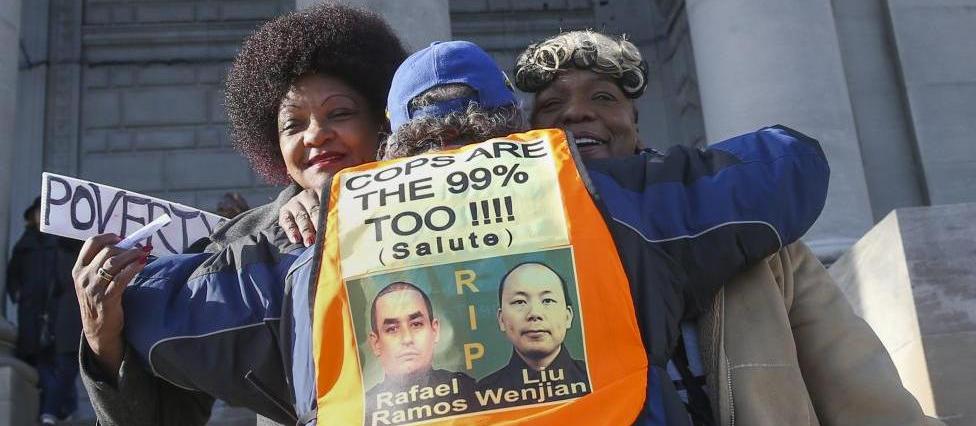
Police 1 (Reuters)

“An attempt to achieve the good by force is like an attempt to provide a man with a picture gallery at the price of cutting out his eyes.”

–Ayn Rand

“They say ‘means are after all means’. I would say ‘means are after all everything’. As the means so the end.”

–Mohandas Gandhi

Reuters image

Principled Means, Principled Ends

There are two reasons why political violence will never get Americans where we want to go. One is tactical. The second is strategic – and far more important.

I do not believe foreign powers will ever seriously challenge our national integrity. 2015 is not 1776. Rather, the danger lies within. The fight involves ideas, and the sincerity of our relationships with one another.

Yet, we seem to hear implied threats of armed rebellion. One hopes the partisan will read the Second Amendment very carefully. (Please see January 2 post.)

Any patriot of today preparing for armed resistance in the tradition of 1776 will pit himself against an extraordinary opponent. He will be outmaneuvered and outgunned by fully militarized police possessing the most advanced surveillance technology and backed by massive firepower.

The mythical ideal of the citizen soldier remains deeply engrained in the American psyche. But the plain fact is, if we imagine a heroic Star Wars scenario in defense of freedom and justice, we are in la-la land.

I am not interested in arguing about this, because there is a much more significant problem with this kind of thinking. And it is this:

American police agencies and the United States military are served by Americans.

As I wrote here last week, violence committed by Americans against Americans would contradict the rationale behind the impetus to violence itself. It would be self-contradictory, pitting us against one another and subverting the integrity and viability of the American Idea as a guiding force for the good.

These are our people, our sons and daughters, friends and neighbors. They are working people. They may be working for deluded or destructive political and economic forces, but they are Americans who should be approached respectfully and won over by persuasive argument and compassionate example.

Our views on government overreach, threats to the integrity of the Constitution, or the loss of liberty in any form are serious matters that must be addressed. But, public servants, police officers and bureaucrats are not the problem.

We must respect these people, not just as a matter of principle, but because we need them. They are essential to a constructive solution.

Any resort to violence within the American community will tear the fabric of the republic and threaten the safety of our families and communities. And, it is simply not necessary.

Some may think the financial elite are our opponents or some dark conspiracy, but it will be our own people, Americans from our own communities, who serve on the front lines arrayed against the self-styled patriot-hero.

Americans will not be persuaded if we are attacked. When people are confronted with hostility we close ranks in self-defense.

Even the misguided rebellion of tiny splinter groups will be destructive to the cause of liberty. This can easily lead to cascading consequences in which violence begets violence in a downward spiral, endangering everyone and threatening the progress of constructive action.

As aggravating as our neighbors may be, it is really not necessary for us to agree about everything. Our differences must be respected, yes. But, if we want to rebuild the foundations of the republic, the American people must rise above our differences to resolve practical problems, define shared values, and together assert the moral center of the nation.

I did not say it would be easy.

The essential question to ask ourselves, and the question by which to judge constructive action, is the spirit and quality of the future we wish to secure. This is not a theoretical nicety. It is a necessity.

Going to war with our fellow citizens would make no sense. Indeed, the ends we seek could be delayed by decades and possibly destroyed by an impractical or intemperate course of action.

Tom

Next week: A Foundation Based on Values