
Freedom and Stability

When the first European settlers came to North America and dispersed into the forests and across the open plains, they had only their own initiative, ingenuity, and self-reliance to depend upon.

No one was there to counsel them about the requirements for survival.  Freedom and responsibility were defined by harsh realities.

Intrepid settlers also relied on one another as neighbors, so long as each took responsibility for themselves.  Self-reliance and the acceptance of personal responsibility are sources of self-respect and lead to mutual respect among neighbors.  Whining and complaint don’t fly, however tough the circumstances.

I believe we will soon find ourselves coming full circle to a time when some of the requirements of frontier life may become necessary once again.

The physical circumstances are different and our independence as self-sufficient individuals is generally gone, but the challenges will increasingly resemble those of an earlier time when we were forced to stand on our own feet, depending on inventiveness, cooperation, and reliability.

In the early years of European settlement, American frontier life required little organization other than that prescribed by the traditions of English common law, and common decency.  But, as populations became more concentrated, it was not long before undisciplined enthusiasm and competitiveness roiled civil order.

Thinking people soon found themselves responding to growing contentiousness – and the dangers of majority rule, which threatened to suppress individual initiative and minority liberties.

Democracy was a new idea 200 years ago.  The Constitutional Convention of 1787 struggled with concerns about the growing intensity of divisiveness in the civil order, and recognition that the future Republic would see changes and stresses that were hard to imagine.

Libertarian sentiments were strong among Americans in the 18th century.  There was a natural fear of the social and political oppressiveness colonists had so recently fled from in their European past.  Many had strong feelings about protecting the freedom they experienced in their daily lives.

Despite deep personal sympathies with this viewpoint, the Founders recognized that majority factions had no compunctions against suppressing the interests or rejecting the needs of anyone who differed with them.  Given a perspective inherited from European history it was easy to imagine a violent and tumultuous future.

The Constitution of the United States is the product of this tension and a determination to create a dynamic framework capable of protecting freedoms and yet absorbing the forces of conflict and change that would surely come.

The Constitution is a legal document, not a guide to rational behavior.  It is designed to provide the stability upon which liberty depends, a structure for governance and a set of practical rules.

It does not supply the values and attitudes, or the crucial necessity for cooperation among equals, upon which its’ effectiveness must depend.

The forthcoming book, on which this blog is based, is largely devoted to this challenge.  Before addressing the future, however, let us first place our current challenges in historical context, and consider the foundational principles and visionary institutions Americans already possess.

How do we understand our role in allowing the Constitution to function according to its’ design and purpose?

How do we understand the true meaning of freedom, and what are the practical constraints required by freedom if it is to survive in an orderly, civilized context?

How did the delegates at the Constitutional Convention of 1787 formulate a structure for governance that would preserve a balance between freedom and stability?  How did they endeavor to encourage a role for civic responsibility that it might prevail into a future they could only barely imagine?

Structural stability is written into the formation of the Republic.  The rest depends on us.  Instability begins with a lack of foresight and an inability to compromise.  Solutions will only be found through moral responsibility, emotional restraint, and cooperative problem-solving.

We stand today at an extraordinary turning point.  Let’s not throw away our inheritance and attempt to start over from nothing.

Tom

Next on the Blog!  The United States Constitution depends on mutual respect and a strong sense of moral and social responsibility, a careful balance that requires commitment to citizenship and readiness to compromise.  Please watch for the next post on or about Friday, October 14.
Knowing Our Strength

The first step is ours to take.  We can address one another with dignity and join with our neighbors to resolve problems and address local needs.  Or, we can accept a world of hostility, disorder, and ultimate collapse as our children’s inheritance – and let the vision and the treasure of the American idea slip away.

The road to security is built with civility and paved with trust.  To make it so will be difficult.  It is, however, the only alternative to disaster.

The argument that the future can only be built on the foundation of dependable communities is as old as history.  It follows from the rational perception that conflict is a condition in human relationships and can only be understood and transcended in and through human relationships.

It is in the struggle with interpersonal relationships that direct and honest communication can take place.  The means for making this fractious process effective in the context of American history is the subject of this blog and forthcoming book.

Some may say that it is too late.  I say that Americans are courageous, resourceful, resilient.  The United States was conceived in controversy, and the pragmatic vision of the Founders came with recognition that wisdom and strength are found in diversity.

Indeed, it will be argued here that diversity is the foundation for strength, and that the United States Constitution is a visionary assertion of this belief.  The Founders gave us structure.  It is our responsibility to make it work.

Our answer to crisis will determine the shape of our future.  We find ourselves confronted today by one of the great tests of history, a challenge to the intent embodied in the Constitution and the coherence of the American vision that has been gradually maturing for more than two hundred years.

Perhaps we have lost our way for periods of time, stumbled, gotten sloppy.  But now it is time to pull together.  It is argued here that this must begin in our local communities – the historic home to pure democracy and the seat of civilization.

In a free society stability cannot be imposed from above. The kind of strength we seek is grounded in trust and the dependability of personal relationships.

I am not writing about a “recovery” from crisis in the normal sense.  Rather, I submit that we stand at the threshold of an unprecedented turning point – a dangerous crossroads, yet one that offers us a unique window of opportunity to affirm and uphold our exceptional and multifaceted identity as a nation.

In navigating through an extraordinary confluence of sequential crises we will be forced to renew our values, think on our feet, and make both pragmatic and ethical adjustments.  A creative process is now underway that would not be possible otherwise.

An assessment of shared values is in order, and reconsideration of the generosity of spirit that once made America so attractive to the world.

In September we will consider the foresight of the Constitutional Convention of 1787 that led to the system of protections, checks and balances that make the American structure of governance what it is.  First, however, we will examine the reasons why diversity has given America a dynamic strength – not as a nice idea, but as a pragmatic imperative.

If American communities are to emerge into a vibrant matrix of local and regional networks, they will depend on citizens with diverse skills and varied perspectives who are capable of teamwork and practical problem-solving.

Resistance to diversity often involves our discomfort with those we perceive as “outsiders”, people who look or think differently than we do, or who come from unfamiliar cultural backgrounds.  Yet, in crises, many differences will allow critical problem-solving that we can ill afford to do without.

It is important to feel confidence in our own ideas and values.  Yes, but why should we be afraid of different ways of thinking?

Aristotle said that “it is the mark of an educated mind to be able to entertain a thought without accepting it.”

The opportunity to explore the world through the eyes of others different from ourselves is a blessing and a gift.  And, in the event of social and economic collapse – it may be the key to survival.

Tom

Please watch for the next post on or about August 19:  The unexpected wisdom in diversity – how it happens and what makes it work.

Cooperation or Collapse?

And what of our differences?  The diversity of views and perspectives that divide Americans in the early years of the 21st century are unquestionably the deepest that have existed since the Civil War.

Our differences are based on many things today: ethical and religious values, economic disparities and personal experience with hardship, our understanding of history, and our perceptions of the very real dangers facing the world.

The vitality of the American Republic has always been energized by the clash of differing opinions.  The national character is rooted in the fertile engagement of divergent ideas that test and expand our wide-ranging perspectives.  America has flourished on the principle of pluralism.

Our opinions, values, perceptions all deserve respect; yet we disagree vehemently on matters of fundamental importance. We have good reasons for holding our views. This is the way it is supposed to be in a healthy civil society.

And this begs a critical question: How can we find a way to live and work together in a time of maximum stress?

As sequential crises take hold, is the security of our families and communities important enough that we are willing to do what is necessary to build trust and dependability, meeting life-sustaining needs and working effectively with our neighbors – many of whom we have substantial differences with?

Are we prepared to struggle for this country shoulder-to-shoulder, indeed to be truly loyal to one another as Americans?

And, what is it really that makes this a cause worth fighting for?

I believe that such questions lead to the pivotal question I have described on this blog as a “severe choice” (June 24).

Many readers have expressed concerns about the imposing challenges these questions represent.  Indeed, we stand at a monumental turning point in the nation’s history.

The survival of the Republic will require certain virtues that Americans are not generally known for—moral responsibility, dependability, trustworthiness.  Our most fundamental challenge will be learning to view others – especially our opponents – in essentially ethical rather than political terms.

This is not about charity.  A level of civility is required that goes far beyond kindness and common decency.  If Americans are to turn the corner, it will be with a civilized and responsible attitude that appears unfamiliar at present.

Cooperation does not require compromising our principles.  Indeed, unexpected opportunities for influencing one another will surely come with working together to address common needs, especially in the face of crises.

Times of danger tend to open ones’ personal perspective, allowing us to see with new eyes and hear with new ears.

It is neither practical nor civilized to go to war with one another when our common interests depend on our ability to communicate clearly and to engage in rational problem-solving.  What is essential is not that we agree, but that we seek dependable cooperation in the face of serious threats.

Naturally, this will require more than a right attitude.  Practical skills will be necessary to help us work effectively in small groups, ensure food security, make consultative decisions and manage conflict, organize projects and start small businesses.

Together we will share and develop the necessary skills.

Under the present conditions of social disintegration, strident divisiveness, and dysfunctional institutions, I have encouraged Americans to turn aside from partisan politics, at least temporarily, to focus primary attention on practical needs in our local communities.

I am not at all opposed to effecting change by traditional means. However, as the crisis deepens I believe we will gain far more safety and control over our lives through community building. And, I believe this effort will impart many of the essential lessons that will lead to a decent future.

This is my message.  Dependable community is the ground of civilization.

However complex the problems we face, in the final analysis we are confronted by a single simple question.  Will we accept the destruction of civilized society, a rending of the very fabric of the Republic, and retreat into a state of siege?  Or, will we have the courage to begin anew?

Tom

A note to readers: Please watch for the next blog post on or about August 5.

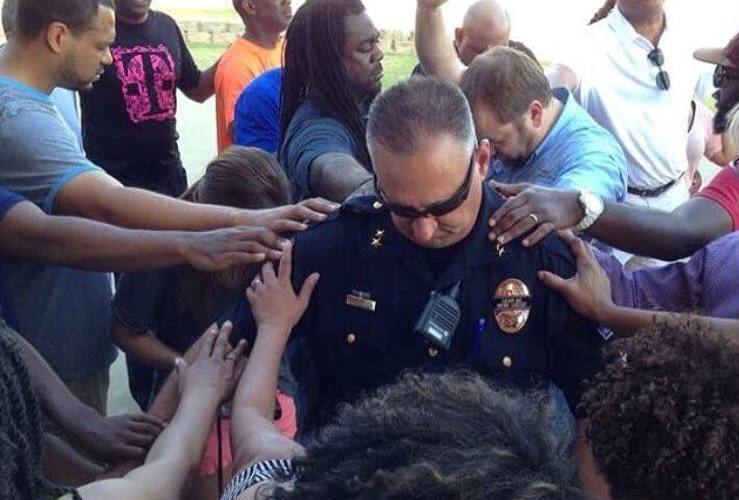
To believe absurdities…

Police 2 (BradWSutton)

“Those who can make you believe absurdities can make you commit atrocities.”  –Voltaire

(Photo credit: Brad W Sutton)


Endurance, Resourcefulness and Faith

The severity of a deepening crisis raises unavoidable questions. Will the country be torn apart by anger and frustration?  Will the nation survive as the Republic created by its founders? Or, will the American people have the vision, fortitude, and grit to learn the lessons and reaffirm the vision and principles that will lead to a genuine renewal?

If the Republic is to prevail, how will we pull it off?  Do we have the patience and wisdom to give priority first to the stability that makes problem-solving possible, to rebuild a national unity that transcends the very real differences that divide us?

Early in 2008 Peggy Noonan, a widely read conservative commentator and one-time aide to President Ronald Reagan, addressed this question eloquently in a collection of essays, Patriotic Grace, What It Is and Why We Need It Now.  She wrote during a season of bitter political back-biting, and, as we all know, things soon became very much worse:

“I believe we have to assume that something bad is going to happen, someday, to us.  Maybe it will be ten years from now, but maybe not, maybe sooner, much sooner.  We have to assume, I think, that it will be a 9/11 times ten, or a hundred, or more, and that it will have a deeply destabilizing effect on our country; that it will test our unity and our endurance, our resourcefulness and faith.

“We all know this, I think, deep down.  I don’t know a major political figure in America to whom all this has not occurred, and often…. And yet in some deep way our politics do not reflect our knowledge.  It’s odd.  Stunning, actually.  We keep going through the same old motions in the bitter old ways.  Even our cynics are not being realistic!

“…Will the banks fail, is the system built on anything but faith, and will the faith hold?  Will we keep our coherence as a country, will we hold together, can we continue as a sovereign nation at peace with itself?”

Peggy Noonan’s little book radiates a much needed spirit.  I recommend it.  Most of us never expected to see the United States in the condition in which we find it today.  Many of us never expected to face the personal hardship in which we increasingly find ourselves.

Ultimately we face a uniquely American crisis, yet one that is unfolding in the midst of an extraordinary global turning point.  I will attempt to cut through the emotions and complexity of a monumental moment in history to argue that we must unite to regenerate and rebuild the United States as a living model for a free, stable, and prosperous world.

This nation has progressed gradually toward maturity for 200 years, dedicated to the cause of responsible liberty and built upon the foundation of unity within diversity – diversity of nationality, religion, ethnicity, and, most of all, political philosophy.  We possess wide ranging distinctions and differences, but together we share an essential inviolable common ground.

We are all Americans.  The promise we all hold dear can only prevail if we have the courage and forbearance to rise above our differences, to address our problems shoulder to shoulder, and to do what must be done to make our children safe and our communities secure.

We have the inherent capacity to move forward despite the mistakes and tragedies of the past – and the mysteries of the future.

Our future hangs in the balance.  Let’s pull together, reassert our common ground in the vision with which the nation was built, and step forward to forge a future shaped by fairness, trustworthiness, and moral responsibility.

I submit to you that something far better, far nobler, something perhaps beyond our present ability to imagine, will emerge from the present turmoil.

If, however, we cannot work effectively to build safe communities with people we are not in complete agreement with, then we will be condemned to the only possible alternative: a collapsing civilization defined by fear and violence, a nightmare for our children, and a land where no principles, no values, no stable order can be realized.

Tom

Next post: Cooperation or collapse?

A note to regular readers:  As I announced in late June, I have shifted to a new schedule and will now post every two weeks.  This will allow me more time for completing the book.  I will continue to post on Fridays and hope to publish the next blog entry on or about July 22.

A Severe Choice

The extraordinary depth and breadth of the many crises confronting the American people today represent a critical turning point and test of America’s place in history.

For more than two hundred years the United States has stood before the world as a beacon of hope and an unparalleled model of political freedom, social diversity, and economic vitality.  People from throughout the world have been attracted to the vision it represents.

In the midst of upheaval it can be easy to forget the unique stature of the United States and the role it has played and will continue to play in the progress of an ever-advancing civilization.  Yet, our confidence in its’ social coherence, its’ economic well-being and generosity of spirit has faltered.

This blog, and the forthcoming book it represents, is addressed to those who are interested in understanding lessons from the past, and who recognize that failures of responsibility and foresight have led us to the brink of disaster.

Do we possess the resolve to join with one another in rebuilding the United States based on its core values and ultimate meaning?

In redirecting our attention and redoubling our commitment, it might be wise to consider those aspects of the American character and cultural attitude that have influenced the downward slide from responsibility to turmoil.

A self-indulgent materialism and thoughtless disregard for the consequences of our actions has placed the future in jeopardy.

The fragmented way we have perceived the world and led our lives may have origins in our immigrant past, but it will not serve us well in reconstructing a stable, coherent, and economically viable future.

There is much to think about.

However, my message is brief.  It will be short on analysis and will forego blame.  There is more than enough blame to go around and we all know about it.  Rather, I will focus on the essentials of mind and attitude, of human character, and of our relationships to one another that will be required if we are to turn despair into courage and failure into triumph.

We will address areas of concern that I believe to be central to realistic solutions.  Most importantly, we will consider the manner in which we relate to one another as individuals when we have very great personal differences.

I submit that the safety and security of our families and communities can only be assured if we unite around the structural order provided by the Constitution, which has anchored the American Republic from its inception, and to the principles of mutual respect and moral responsibility that give strength and resiliency to all civilized societies.

The United States has entered the fiery test of a crucible in which the forces of crisis will burn away the self-centeredness and sloppy thinking of the past to forge an American identity we can respect and feel good about.

If we fail to rise to our calling, however, the social violence generated by failing institutions and human suffering will threaten to incinerate our children’s future and turn a great vision to hopelessness and anguish.

At a time of extraordinary existential threat we are confronted with a severe choice.

Will we return to the founding ideals and principles of these United States as the bedrock on which to build a free and ethical future?  Will we defend and protect two hundred years of commitment, hard work, and sacrifice by generations of Americans who have given their lives to this unprecedented vision?

Or, will we give way to the emotions of uncompromising partisanship – and allow a great trust to shatter and vanish?

Infrastructure, systems, and services we have long depended upon are going to fail in the coming years. Problems will have to be solved without many of the tools and supports to which we are accustomed.  We will need to depend on one another in our local communities.

So, let’s set aside partisanship and sectarian differences when it becomes necessary in the interest of stabilizing and rebuilding the nation. Panic neither serves nor becomes us.

Tom

A note to regular readers:  Starting in July, I intend to post on alternate weeks.  This will allow me more time for completing the book.  I hope to post the next blog entry on or about July 8.  Have a good summer!

Principled Means, Principled Ends

These are precarious times.  We find ourselves confronted with growing social and economic instability and an uncertain future.  We do not want to sit on our hands.  Yet, unprecedented complexity and uncertainty make it impossible to know what to expect.

How easy it would be to let emotions rule, tipping the future into chaos and endangering the very goals we wish to secure.

It is with this in mind that I take up where I left off in the previous post (June 9).  I see two pragmatic reasons why political violence will not get Americans where we want to go.  One is tactical.  The second is strategic – and the more important.

Any patriot preparing today for armed resistance in the tradition of 1776 will pit himself against an extraordinary opponent.  He will be outmaneuvered and outgunned by fully militarized police possessing the most advanced surveillance technology and backed by massive firepower.

The mythic ideal of the citizen soldier remains deeply engrained in the American psyche.  But the plain fact is, if you imagine a heroic Star Wars scenario in defense of freedom and justice you are indulging in fantasy.

I am not interested in arguing about this because there is a much bigger problem, and it is this:  Who exactly do you intend to fight?

American law enforcement agencies and the United States military are served by loyal, committed Americans.   These are our people, our sons and daughters, friends and neighbors.  They are working people, they have families, and they care about the future.

It is our responsibility to win them over, not beat them up.  They should be approached respectfully, with persuasive argument and attractive example.

As I wrote here last week, violence committed by Americans against Americans would contradict the rationale behind the impetus to violence itself.   It would be self-contradictory, pitting us against one another and subverting the integrity and viability of the American Idea as a guiding force for the good.

Our views on politics or government, the integrity of the Constitution, or the corruption of principles, are all serious matters.  But, public servants, police officers and bureaucrats are not the problem.

We must respect these people, not just as a matter of principle, but because we need them. They are essential to a constructive solution.

Americans are not to be persuaded when we are attacked, not for some high-minded cause or anything else.  When faced with hostility we naturally close ranks, and clear thinking stops.

Even the misguided rebellion of tiny splinter groups will be destructive to the cause of liberty.  Any resort to force can easily lead to cascading consequences in which violence begets violence in a downward spiral, tearing the fabric of the republic and threatening the progress of constructive action.

Furthermore, it is simply not necessary.

Change is needed that is real, lasting, and built on the solid ground of dependable communities – not quicksand.  I never said this would be easy, so let me be clear – the skills, attitudes, and discipline that create and build community are at the heart of what we need to learn to create and build the future.

This is more than a matter of survival.  For thousands of years community has formed the foundation of civilization.  The essential concern in the present hour, and the basis by which to judge constructive action, must be the spirit and the quality of the future we wish for.  It is the means that determine the end.

This is not a theoretical nicety, but hard-nosed truth.  Understanding it will determine success or failure.

We are capable of being decent, patient and forbearing, of cooperating to resolve practical problems and even saving each others’ lives.  Personal principles, values and views must certainly be respected.  But, rising above our differences will be essential if we are to identify shared values, ensure comprehensive security, and begin to build a stable social economy for the future.

Going to war with our fellow citizens would make no sense.  Indeed, the ends we seek could be delayed by decades and possibly destroyed by impractical or intemperate courses of action.

Tom

Next week: A Foundation Based on Values

A note to regular readers: Thank you for all the comments, ideas, and perspectives shared in recent weeks, especially on the Facebook page.  You are a valuable “reality test” for me as a writer.  This project would be impossible without you.

Ends and Means…

Music 4-x

“The principle that the ends justify the means is in individualist ethics regarded as the denial of all morals”

–F. A. Hayek

“He who chooses the beginning of the road chooses the place it leads to.  It is the means that determine the end.”

–Harry Emerson Fosdick

“An attempt to achieve the good by force is like an attempt to provide a man with a picture gallery at the price of cutting out his eyes.”

–Ayn Rand

“They say ‘means are after all means’.  I would say ‘means are after all everything’.  As the means, so the end.”

–Mohandas Gandhi

“The first sign of corruption in a society that is still alive is that the end justifies the means.”

–Georges Bernanos


From Darkness to Light

Without safe communities, and neighbors we can depend on, how will we find security for our families or begin to create a future we can believe in?  Tell me, please, in what other place do we have the freedom and the opportunity to build a stable civil order?

Do we imagine that a shining superhero will ride to our rescue?  Or will we, as I asked last week, pick ourselves up and do what needs to be done?

This is an uncompromising question.  Not to answer it, or to defer commitment, is in fact to answer it.  Failure to rise to necessity is to accept defeat.

Whatever our personality, our political philosophy or religious belief, the individual has an unavoidable choice to make.  Either we retreat into ourselves, accepting what is given as beyond our control, or we step forward to engage hardship and purpose with constructive intent.

This is a very personal choice, but at a time of existential crisis for the United States it takes on great importance – not only for ourselves, but for America and the world.

The United States has served as a model for governance and an engine of creative vitality that is unparalleled in human history.  The American idea has been a beacon of hope for people everywhere.  There has never been anything else like it.  And, the world is watching.

To hesitate here would be to respond as victims rather than as citizens.  It would be to choose loss over promise, helplessness over responsibility.  We may be temporarily intimidated by difficult circumstances.  But we must never give in and never lose sight of the dawn of the new day that even now lights the horizon.

Living with purpose gives us courage and inspiration.

I never said it will be easy.  It will not.  What I am saying is that we have no choice.  Without the courage to begin anew, we will join the slide into chaos.

Standing firm in the context of community does not isolate us from uncertainty.  It will provide only limited protection from the confusion around us.  What it does is keep us close to trustworthy and dependable friends and neighbors.

It positions us to best keep our balance, mentally and spiritually.  And, it keeps the potential for an American future alive.

Working with people is probably the most challenging part of life.  Choosing to take control of our destiny will require perseverance and forbearance – a readiness to exercise tolerance, patience, self-control.  Communicating effectively will become a necessity.

There will always be difficult people to test us.

Our job is not to be heroes.  Our job is to win over hearts and minds to the cause of safety, mutual respect, and rational governance.  Only then will it be possible for fear to give way to curiosity, for judgmental attitudes to be replaced with genuine listening and compassionate understanding.

Progress will come just one step at a time, and will often seem painfully slow.  Making a commitment to stay positive can require considerable resolve.  But, holding to the truth in our vision, focusing on productive purpose, and building trustworthy friendships – can make a very big difference.

The negativity that surrounds us may appear powerful, but in reality it can only exist in the absence of constructive action, and it only has the energy we grant it.  When we set out on a practical path and offer encouragement to others with a radiant spirit, we become as a light that pushes back the darkness.

If we are met with overbearing negativity, it may be wise to take our energy elsewhere.  But, we must never allow our vision to dim or our compassion to be compromised.

Darkness can always be countered with light.  Darkness is the absence of light and has no substance of its own.  The light of a small candle defies and defeats even the darkest night.

Tom

Next week:  Finding courage in crisis.

A note to new readers:  Blog entries adapted from the forthcoming book are posted on most Fridays at both this, the main blog site, and on the Facebook page.  To receive alerts by email you may click “Follow” on this site.

Never doubt that a small group…

Background 5

“It does not take a majority to prevail, but rather an irate, tireless minority, keen on setting brushfires of freedom in the minds of men.”

–Samuel Adams

“Never doubt that a small group of thoughtful, concerned citizens can change the world.  Indeed it is the only thing that ever has.”

–Margaret Mead

America at a Tipping Point

To speak of rebuilding the foundations of the Republic is not to suggest deficiencies in the structure and process of governance provided by the Constitution.  On the contrary, the founders created a structural bulwark for stability that must be defended vigorously whenever necessary.

The foundation many of us are concerned about is that of integrity: Justice, trust, responsibility, and a mutual respect that transcends differences among citizens.

A reader commented on this blog’s Facebook page last week that, “America is at a tipping point because every tenet [and] moral fiber of this nation has been diminished, so that no one is held accountable.  [There is] no moral compass because the foundations are removed.”

We do not have to agree on all the details to recognize truth in this view.  And, we cannot wait for somebody else to fix it.  It is time to stop complaining and to step forward to engage with those around us in securing the safety and well-being of our communities.

Changing our attitude does not require changing opinions or compromising principles.  Addressing people and problems with dignity and kindliness will win respect, not harsh or derogatory words.

If we wish to be heard, to share our views and represent our principles, we must do what is necessary to make this possible.  Communication and understanding will not be easy until we are cooperating shoulder-to-shoulder with our neighbors to make things right.

No, it will not be easy.  But this is how mutual respect begins and the ability to listen becomes genuine.

We will talk more about this later, but the important thing to recognize is that when the going gets tough, relationships count.  I don’t just mean next door neighbors, as important as they are.  If we find ourselves under threat, directly or indirectly, the last thing we need is neighbors down the road or over the hill who are an unknown quantity.

And, we are not simply talking about making acquaintances here.  This is not about borrowing a cup of sugar over the back fence.  To create safe communities – to rebuild the nation – we need dependability.  And that means trust.

Yes, well, in the midst of this crisis we find that trust is not something that Americans know much about.  Mostly we do not believe in it any more.  This is a big problem.

We cannot simply start trusting people because we wish to be trusting.  The reality we live in is decidedly untrustworthy.  Most of the people around us do not have a clear concept of what trust means, much less an understanding of why it is important or what to do about it.

Change will take time.  The challenge begins with our willingness to take initiative, to be patient, to accept differences, and, most of all, to listen to others with interested curiosity.  If we wish to be heard it is usually necessary to first convince others that we are actually hearing them.  Only then will we be heard.

In his book, “The Seven Habits of Highly Effective People“, Stephen Covey wrote:

“If you’re like most people, you probably seek first to be understood; you want to get your point across. And in doing so, you may ignore the other person completely, pretend that you’re listening, selectively hear only certain parts of the conversation or attentively focus on only the words being said, but miss the meaning entirely. So why does this happen? Because most people listen with the intent to reply, not to understand.”

We can all see that the loss of trust has accompanied the loss of civil order and security in this country.  We know there are serious structural problems that must be addressed, but I hope we can also see why trust will serve a vital role in recovering stability and prosperity.

Learning how to build trust will come in the context of practical experience – teaming up to work closely with one another, resolving practical problems and meeting needs in our communities.

Without trust the American republic faces existential danger.  And, without personal cooperation and understanding no trust is possible and no progress is attainable.

Tom

Next week: Finding our balance in the storm

Dear readers, I would appreciate your feedback: ideas, viewpoints, and observations.  Expansive reader engagement on the Facebook page has been quite helpful.

Living with Integrity

I have suggested here that liberty is closely related to justice, and that both depend upon moral responsibility.  How can we think about these things, and find integrity in them and through them?

By responsibility I mean active engagement with the people and institutions around us as interested and caring citizens.  Responsibility gives meaning and order to our lives.  It is a partner to liberty, which cannot exist without it.

I refer to moral responsibility more specifically as our ability to respond on the basis of conscience, using personal judgment regarding what is right and wrong in human behavior, and acting with respect for the dignity of those we encounter.

A friend once pointed out to me that the meaning of “responsibility” might be found in the compound word, “response-ability.”  Without this ability, justice cannot be realized and liberty has no purpose.

We heard from Viktor Frankl several weeks ago in a post entitled: “The Resilience of Inner Freedom.”  Dr. Frankl emerged from his World War II ordeal in a Nazi death camp with the firm conviction that freedom can only be secured through responsibility.

Freedom,” he wrote, “is not the last word.  Freedom is only part of the story and half of the truth.  Freedom is but the negative aspect of the whole phenomenon whose positive aspect is responsibleness.  In fact, freedom is in danger of degenerating into mere arbitrariness unless it is lived in terms of responsibleness.”

For many of us, seeking freedom in our lives is a gradual process of maturing, letting go of dependencies, and trying to make a go at life with what resources we can gather or create.

This is meaningful for a time.  However, we soon begin to realize that the society in which we live, and the material limitations in our lives, impose themselves on us in uncomfortable ways.

Do we then give in to anger – or feeling sorry for ourselves?  Or, do we seek dignity in the face of limitation, asserting control over our personal vices, and engaging constructively in our community and the wider world beyond?

Many of us find it necessary to construct the lives we wish for from the wreckage of past mistakes, our own and those of others, and are grateful simply for the opportunity to do so.  Even cleaning up a mess offers a certain satisfaction.

There is no happiness to be found in complaining.  Self-respect cannot wait for things to change.  We are each capable of responding to the world around us with dignity and creativity.

Contributing to problem-solving in collaboration with others is a choice that can bring great gratification, however difficult the challenges.

Accepting responsibility can mean many things depending on our circumstances.  Usually we think of responsibility as the act of responding to what needs to be done.  I suggest, however, that a core responsibility underlying all others is the imperative to build and ensure trust.

Without trust, the fabric of this nation will continue to disintegrate.  Trust is the substance of integrity and the single most essential factor making it possible for us to build the future.

Can we find ways of thinking and being that are consistent with the foundation of justice we have considered in recent posts?  The integrity of such a framework supports our endeavors in the same way that a sound physical foundation is required to construct a building.

A principled integrity gains primacy in our very identity: our character and way of being.  But, it can easily be squandered in a moment of carelessness.

So, there you have it: Integrity is the quality of being; trustworthiness is the substance of that quality; and, responsibility is the action with which we make it so.  And, finally, justice is the beginning and the end, the matrix that holds it all together.

Responsibility follows immediately from integrity and is the expression of it.  Stability and order depend on this.  When responsibility is understood and applied to the challenges we face, progress is possible.  Otherwise the integrity of intention is lost.

There is no middle ground.  Either integrity and responsibility are wholly present or they are compromised.  Without them no civilization is possible.

Tom

Next week:  On dependability and trust

A note to regular readers:  I wish to express my gratitude for the interest and constructive feedback you have shared on the Facebook page.  I could not reasonably proceed without this.  Those of you who have taken the step of clicking “Follow” on this site are also serving a significant role.  When it comes time to publish, the numbers really can make a difference.