
Values That Matter

Readers responded last week to my request for thinking about shared values for a genuine American renewal. What values can we agree on, I asked, as a foundation for a unified starting point – a common American “center” that transcends culture, religion, politics?

[This exchange of ideas took place primarily on the blog’s Facebook page, where more than 80 readers clicked post like: http://www.facebook.com/freedomstruth ]

Ideas were offered and important points were made. Values were identified and we heard the deeply felt need for government policies that reflect them. Frustrations were expressed, as well as some feelings verging on hopelessness.

I wrote of my belief that a small unified core of determined Americans could generate a powerful moral presence, if we articulate essential values clearly and project a vision for the future with a compassionate and welcoming spirit.

This would be immensely attractive to a nation desperate for the feel of solid ground beneath its feet.

A dynamic initiative will not require large numbers at the start. It will grow rapidly. I believe the vision of a civil order based on trust and responsibility will draw Americans to it from every walk of life – from every religious faith, from every economic condition and political philosophy.

A signed pledge would make individual commitment very clear. Such a pledge could be added in the back of the book, if you think this is a good idea. Please let me know what you think.

The hard part is this: It will require a willingness to temporarily set aside some of the political differences that separate us – until such time as we have secured the stability necessary to address common problems in our communities.

What is essential is not that we agree on every aspect of personal belief, but that we join with one another to restore the integrity of a civil society that allows for constructive cooperation, engaging with one another respectfully, so that we can secure the safety of our families and the economic well-being of local and regional communities.

If this is our priority we cannot allow America to disintegrate in unrestrained acrimony and hostility. We will have to choose our battles. Some will have to be fought on another day.

My request for your thinking may not have been clear regarding the distinction between government policies and the principles behind them. My intention here is to take the first step in building a foundation on which we can then proceed to structure debate and build policy.

Among genuinely committed Americans, finding common ground in our values will alter perceptions and increase our ability to actually listen to one another.

Stephen Covey wrote that “most people listen with the intent to reply, not to understand.” If Americans are to recover the vision of this country as free and fair, this will have to change.

In his best-selling book, The 7 Habits of Highly Effective People, Stephen Covey wrote:
Every human has four endowments — self awareness, conscience, independent will and creative imagination. These give us the ultimate human freedom, the power to choose, to respond, to change.

Our challenge is to establish a condition, a mental space, in which we can sustain this freedom and attract our fellow-Americans to it.

Having asked you last week to identify the values that should characterize such a condition, I will share those that I consider essential for a free and just society.

I add these to our commitment to defend the Constitution and respect the rule of law: Justice, equity, truthfulness, honesty, fair-mindedness, reliability, trustworthiness, and responsibility.

There you have it. These values are essentially universal, having been taught by every world religion down through the ages. Unfortunately, many of the followers of religion don’t get it, and so our work is cut out for us.

I would appreciate receiving another round of feedback from readers. Please focus your comments on basic values and the principles to live by – and share the reasons why you think the future of the world depends upon them.

Tom

In the coming weeks: Economic reconstruction and a future built on fairness.

Note to readers: You can support this blog and the book project by suggesting that your friends and associates take a look.
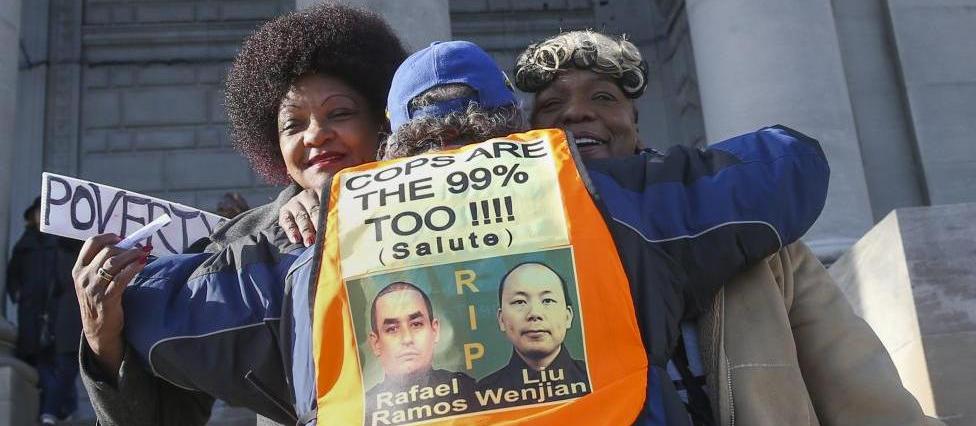

Keeping Our Eyes on the Prize

Police 1 (Reuters)

“An attempt to achieve the good by force is like an attempt to provide a man with a picture gallery at the price of cutting out his eyes.”

–Ayn Rand

“They say ‘means are after all means’. I would say ‘means are after all everything’. As the means so the end.”

–Mohandas Gandhi

Reuters image

The Second Amendment, Then and Now

The Bill of Rights, which includes the first ten of the amendments to the Constitution, was first proposed to Congress by James Madison as articles to be incorporated into the main body of the Constitution.

Congress approved twelve articles of amendment to the Constitution in 1789 and submitted them to the states for ratification. Contrary to Madison’s proposal, they were submitted as “supplemental” additions. Articles Three through Twelve were ratified by the required number of states and became Amendments One through Ten in 1791.

The Second Amendment, which has become a matter of considerable interest in recent years, reads as follows:

“A well regulated Militia, being necessary to the security of a free State, the right of the people to keep and bear Arms, shall not be infringed.”

This was not controversial at the time. The concept existed in English common law long before the enactment of the Bill of Rights. And for a variety of reasons today many Americans feel it is necessary to own firearms.

The importance of this issue to the founders was quite clear. James Madison introduced the language that became the Second Amendment and also wrote: “The Constitution preserves the advantage of being armed which Americans possess over the people of almost every other nation where the governments are afraid to trust the people with arms.”

Alexander Hamilton, like Madison a strong advocate for Federalism, was equally explicit: “The constitution shall never be construed…to prevent the people of the United States who are peaceable citizens from keeping their own arms.”

Thomas Jefferson famously said: “No freeman shall be debarred the use of arms.” And he also wrote that “The strongest reason for the people to retain their right to keep and bear arms is as a last resort to protect themselves against tyranny in government.”

During the years leading up to the Revolutionary War there was mob violence in several of the colonies. In addition, many American lived in or close to wilderness regions where conditions were essentially lawless. The need people felt to protect their families was quite rational.

It should be noted that a primary motivation for supporting “a well regulated Militia,” articulated in the Second Amendment as “being necessary to the security of a free State,” was the strong opposition among the founders to the concept of a standing army.

Thomas Jefferson put it this way: “None but an armed nation can dispense with a standing army. To keep ours armed and disciplined is therefore at all times important.” “Every citizen should be a soldier,” he wrote. “This was the case with the Greeks and Romans, and must be that of every free state.”

The American reality in 1776 and 1791 was entirely different from that confronting us today. Yet, news of social, religious, and psychopathic violence imposes itself on us every day. Older Americans are particularly sensitized to what has changed: the radical loss of trust and the lack of civility, ethical integrity, and social responsibility we see everywhere.

We must acknowledge the compelling reasons why so many feel it necessary to own firearms.

That said, however, I must tell you I believe the use of force among Americans today, in defense of the Constitution and the American freedoms, would be counterproductive and incompatible with an effective strategy.

Our consideration in recent posts of the dynamic relation of means to ends should, in my view, make this clear.

Violence committed by Americans against Americans would contradict the rationale behind the impetus to violence itself. It would be self-contradictory, pitting brother and sister against brother and sister, subverting the integrity and viability of the American Idea as a guiding force for the good.

We can do far better.

I have presented principles supporting this assertion in previous posts, (see especially Nov 28 and Dec 12), and will offer a more explicit argument next week.

We need to consider this carefully and get it right. We face a long crisis. Many dark and dangerous things are possible.

Tom

Next week: Principled Means, Principled Ends

Note to readers: You can support this blog and the book project by suggesting that your friends and associates take a look.

Doing What’s Necessary

Farm 10

“Start by doing what’s necessary; then do what’s possible; and suddenly you are doing the impossible.”

–Francis of Assisi

To Strengthen the Soul

Storm

“Comfort and prosperity have never enriched the world as much as adversity has.”
— Billy Graham

“Character cannot be developed in ease and quiet. Only through experience of trial and suffering can the soul be strengthened, ambition inspired, and success achieved.”
— Helen Keller

“Nothing will work unless you do.”
— Maya Angelou

Citizen Initiative, Civil Society

Whatever happened to the creative power of American civil society? What is the consequence of this loss?

Tocqueville reported in 1840 that Americans overcame constraints on their freedom through their own initiative and sense of community. But, 174 years later, action has been replaced by inaction. A once spirited culture of engagement, built on committed interpersonal relationships, has been replaced by an increasingly self-centered attitude, the loss of community, and the isolating influences of the automobile, television, and the digital age.

Is it these technologies that have isolated us from one another? Niall Ferguson argues no. Rather he suggests that it is “not technology, but the state – with its seductive promise of ‘security from the cradle to the grave’ – [which is] the real enemy of civil society.” And he cites the astonishingly prophetic vision of Tocqueville, who imagined a future America in which the spirit of community has been co-opted and neutered by government:

“I see an innumerable crowd of like and equal men who revolve on themselves without repose, procuring the small and vulgar pleasures with which they fill their souls. Each of them, withdrawn and apart, is like a stranger to the destiny of all the others: his children and his particular friends form the whole human species for him; as for dwelling with his fellow citizens, he is beside them, but he does not see them; he touches them and does not feel them; he exists only in himself and for himself alone….

“Above these an immense tutelary power is elevated, which alone takes charge of assuring their enjoyments and watching over their fate. It is absolute, detailed, regular, far-seeing, and mild. It would resemble paternal power if, like that, it had for its object to prepare men for manhood; but on the contrary, it seeks only to keep them fixed irrevocably in childhood….

“Thus, …the sovereign extends its arms over society as a whole; it covers its surface with a network of small, complicated, painstaking, uniform rules through which the most original minds and the most vigorous souls cannot clear a way to surpass the crowd; it does not break wills, but it softens them, bends them, and directs them; it rarely forces one to act, but it constantly opposes itself to one’s acting; it does not destroy, it prevents things from being born; it does not tyrannize, it hinders, compromises, enervates, extinguishes, dazes, and finally reduces each nation to being nothing more than a herd of timid and industrious animals of which the government is the shepherd.”

Elsewhere Tocqueville added an explicit warning:

“But what political power would ever be in a state to suffice for the innumerable multitude of small undertakings that American citizens execute every day with the aid of association?…

“The morality and intelligence of a democratic people would risk no fewer dangers than its business and industry if government came to take the place of associations everywhere.

“Sentiments and ideas renew themselves, the heart is enlarged, and the human mind is developed only by the reciprocal action of men upon one another.”

I agree that government has had a part in the demise of the American soul. But, I do not think we can attribute the present condition solely to government. I believe the degeneration of attitudes and behavior cannot be divorced from the isolating influences of corporate culture, the dispersion of communities by the automobile, or the superficiality of a digital society.

Telecommunications and travel by air brought the world together on a macro level, but they also disinclined us to engage with our neighbors. I believe the long slide to isolation is the consequence of social forces that have tracked the trajectory of human progress since the founding of the Republic, and which we can only fault ourselves for accepting without question.

Our government is, after all, a creature of our own invention, served by people who have been subject to the same deterioration of values and responsibility as the nation as a whole.

Tom

The Creative Power of American Civil Society

We face a turning point as a nation that is quite challenging. Yet, it is also an opportunity; a rare moment in history that calls us to clarify our purpose and correct the manner of thinking that brought us to this place. It will require that we keep our minds open and remain objective as we address some tough questions. The effort may not be comfortable, but it is essential if we are to regain our balance and rebuild our resolve.

In his recent book, The Great Degeneration, economic historian Niall Ferguson has provided us with a compelling review of what has come to pass. He considers four areas in which the degeneration of values and social stability in the United States has had devastating consequences. These are, to use my own words, 1) the role of responsibility in the structure of the social order, 2) the disintegration of the market economy, 3) the fundamental role of the rule of law, and 4) the essential qualities of civil society.

Looking back, Dr. Ferguson reminds us of the vigorous civil and cultural life of nineteenth century America: “I want to ask,” he writes, “how far it is possible for a truly free nation to flourish in the absence of the kind of vibrant civil society we used to take for granted? I want to suggest that the opposite of civil society is uncivil society, where even the problem of anti-social behavior becomes a problem for the state.” (2013)

He goes on to cite Alexis de Tocqueville from the first volume of his famous commentary, Democracy in America, which was published in 1840:

“America is, among the countries of the world, the one where they have taken most advantage of association and where they have applied that powerful mode of action to a greater diversity of objects.

“Independent of the permanent associations created by law under the names of townships, cities and counties, there is a multitude of others that owe their birth and development only to the individual will.

“The inhabitant of the United States learns from birth that he must rely on himself to struggle against the evils and obstacles of life; he has only a defiant and restive regard for social authority and he appeals to its authority only when he cannot do without it…. In the United States, they associate for the goals of public security, of commerce and industry, of morality and religion. There is nothing the human will despairs of attaining by the free action of the collective power of individuals.”

Dr. Ferguson writes that “Tocqueville saw America’s political associations as an indispensable counterweight to the tyranny of the majority in modern democracy. But it was the non-political associations that really fascinated him”:

“Americans of all ages, all conditions, all minds constantly unite. Not only do they have commercial and industrial associations in which all take part, but they also have a thousand other kinds: religious, moral, grave, futile, very general and very particular, immense and very small; Americans use associations to give fêtes, to found seminaries, to build inns, to raise churches, to distribute books…; in this manner they create hospitals, prisons, schools. Finally, if it is a question of bringing to light a truth or developing a sentiment with the support of great example, they associate.”

What happened to the creative power of American civil society? And, what is the consequence of this loss? As Tocqueville reports so well, Americans succeeded in overcoming constraints on their freedom through their own initiative and sense of community.

Unfortunately, action has been replaced by inaction. A once spirited culture of engagement, based on committed interpersonal relationships, has been replaced by a self-centered attitude, the loss of community, and the isolating influences of the automobile, television, and the digital age.

Surely it is time to restore what we once did so well, and then, with renewed strength, to address the great challenges ahead.