
A Foundation for Renewal

I cannot imagine an American renewal without a meaningful dialog concerning values.

Can we rise above our differences as Americans to agree on the most basic of shared values? Will a courageous few stand together to agree on a unified starting point – a common American “center” that transcends culture, religion, politics?

Will the center hold?

It is difficult to visualize how this can happen, yet I believe we can do it and will do it. I believe it possible in part because it is not necessary to begin with large numbers. A small unified core of determined Americans can make this happen, citizens with the tenacity and open-minded compassion necessary to assert a powerful moral presence.

If we are willing and able to present a vision for the future with a generous and welcoming spirit, it will be immensely attractive to a nation desperate for the feel of solid ground beneath its’ feet.

I believe the vision of a civil order based on trust and responsibility will draw Americans to it from every walk of life – from every religious faith, from every economic condition and political philosophy.

And, yes, this begs a question. How can we agree? We have substantial differences. This is the hard part.

What is essential is not that we agree on every aspect of personal belief, but that we join with one another to restore the integrity of a civil society that allows for constructive cooperation, engaging with one another respectfully, so that we can secure the safety of our families and the productivity of our communities.

If this is our priority we cannot allow America to disintegrate in unrestrained acrimony and hostility. We will have to choose our battles. Some will have to be fought on another day.

James Madison fought to have slavery abolished in the Constitution when it was first drafted in 1787. It was painful for him to walk away from that vision, but he realized it threatened to kill the entire project. It took decades of determination for abolitionists to finally get the job done.

Today, however, agreement on certain principles will be immediately necessary. What must these be?

What are the core principles that will put America on the road to a dynamic future? Not the core principles held dear by each of us personally, but the essential principles required to pull a diverse people together as a nation.

Each of us will have to decide what we can accept in a healthy, diverse, pluralistic American society. Each will need to consider the extent to which we are prepared to engage in meaningful dialog and debate concerning this question.

I have suggested several principles in these blog posts that I consider essential. In addition to a firm defense of the Constitution, I have written of the necessity for trustworthiness, for responsibility, and the concept of constructive action – action based on the principle of refusing to hurt or do harm, whether by impatience, dishonesty, hatred, or wishing ill of anybody.

(See especially September 26, Foundation of Trust; October 12, Bringing Light to Darkness; October 17, Finding Courage in Crisis; and December 12, First Principles.)

Now I would like to hear from readers. What principles would you ask your fellow Americans to commit themselves to? Please contribute your comments.

And, what of those who remain hardened in attitude, closed-minded, or confused? What of those who simply refuse to accept any kind of responsibility?

We must stand firm in the midst of chaos and not be moved from our choice of principles or our determination to rise above our differences.

A fully American vision can only be reached through thoughtful consultation – by discussing our hopes and beliefs with one another in good faith, exploring the fault lines where we can find common purpose and a higher calling.

A valid vision of the future will require genuine engagement and understanding. Only then can we start working together on real problems and real needs.

We are either all in, building a free, fair, and productive society, or we are each on our own in a devastated world.

Tom

A note to readers: Please share your thinking about principles and fundamental American values in your comments.
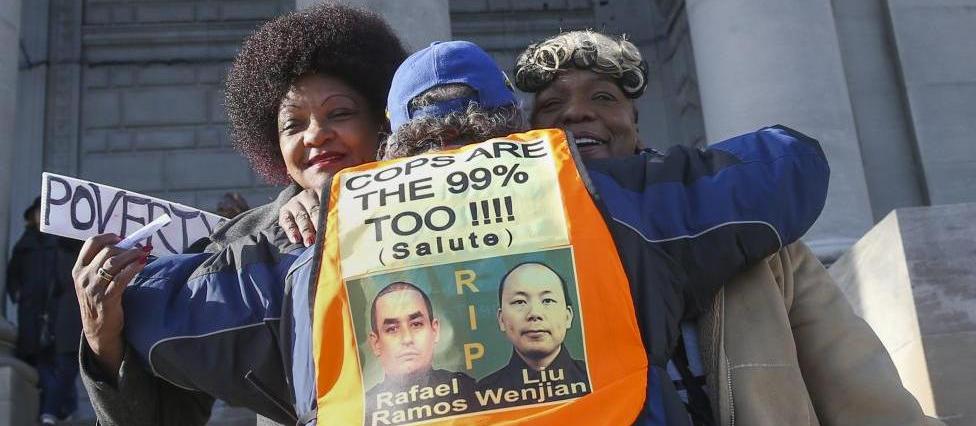
Keeping Our Eyes on the Prize

Police 1 (Reuters)

“An attempt to achieve the good by force is like an attempt to provide a man with a picture gallery at the price of cutting out his eyes.”

–Ayn Rand

“They say ‘means are after all means’. I would say ‘means are after all everything’. As the means so the end.”

–Mohandas Gandhi

Reuters image

Principled Means, Principled Ends

There are two reasons why political violence will never get Americans where we want to go. One is tactical. The second is strategic – and far more important.

I do not believe foreign powers will ever seriously challenge our national integrity. 2015 is not 1776. Rather, the danger lies within. The fight involves ideas, and the sincerity of our relationships with one another.

Yet, we seem to hear implied threats of armed rebellion. One hopes the partisan will read the Second Amendment very carefully. (Please see January 2 post.)

Any patriot of today preparing for armed resistance in the tradition of 1776 will pit himself against an extraordinary opponent. He will be outmaneuvered and outgunned by fully militarized police possessing the most advanced surveillance technology and backed by massive firepower.

The mythical ideal of the citizen soldier remains deeply engrained in the American psyche. But the plain fact is, if we imagine a heroic Star Wars scenario in defense of freedom and justice, we are in la-la land.

I am not interested in arguing about this, because there is a much more significant problem with this kind of thinking. And it is this:

American police agencies and the United States military are served by Americans.

As I wrote here last week, violence committed by Americans against Americans would contradict the rationale behind the impetus to violence itself. It would be self-contradictory, pitting us against one another and subverting the integrity and viability of the American Idea as a guiding force for the good.

These are our people, our sons and daughters, friends and neighbors. They are working people. They may be working for deluded or destructive political and economic forces, but they are Americans who should be approached respectfully and won over by persuasive argument and compassionate example.

Our views on government overreach, threats to the integrity of the Constitution, or the loss of liberty in any form are serious matters that must be addressed. But, public servants, police officers and bureaucrats are not the problem.

We must respect these people, not just as a matter of principle, but because we need them. They are essential to a constructive solution.

Any resort to violence within the American community will tear the fabric of the republic and threaten the safety of our families and communities. And, it is simply not necessary.

Some may think the financial elite are our opponents or some dark conspiracy, but it will be our own people, Americans from our own communities, who serve on the front lines arrayed against the self-styled patriot-hero.

Americans will not be persuaded if we are attacked. When people are confronted with hostility we close ranks in self-defense.

Even the misguided rebellion of tiny splinter groups will be destructive to the cause of liberty. This can easily lead to cascading consequences in which violence begets violence in a downward spiral, endangering everyone and threatening the progress of constructive action.

As aggravating as our neighbors may be, it is really not necessary for us to agree about everything. Our differences must be respected, yes. But, if we want to rebuild the foundations of the republic, the American people must rise above our differences to resolve practical problems, define shared values, and together assert the moral center of the nation.

I did not say it would be easy.

The essential question to ask ourselves, and the question by which to judge constructive action, is the spirit and quality of the future we wish to secure. This is not a theoretical nicety. It is a necessity.

Going to war with our fellow citizens would make no sense. Indeed, the ends we seek could be delayed by decades and possibly destroyed by an impractical or intemperate course of action.

Tom

Next week: A Foundation Based on Values

A House Divided…

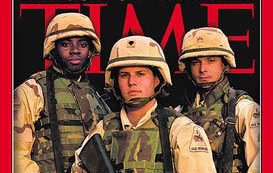
Soldier 3

“A house divided against itself cannot stand.”

–Abraham Lincoln